Showing posts with label cat. Show all posts

Monday, May 10, 2010

Ah, the darling buds of May!

Seems like summer has sprung, full blown, from the hopeful days of March and April. Spring has flown by on beautiful gossamer wings, flitting off in such haste that has left me shouting, "Wait! I'm not done with you yet, I didn't get to see.....where are you going so fast?" Already the roses are overnight bursting into full bloom, and the rhododendrons haven't even finished opening up.


Red Knockout Rose!

We have been gone for 4 days, at the Tri-State Gem and Mineral Show here. It was an outdoor show, and it alternately rained, hailed, and gusted windily (is that a word? ha!) except for the last day, and most of it it was absolutely miserable, wet and chilly. So coming back to the garden was truly a marvelous adventure. With the rain and a couple of days of sunshine, everything seems to be twice the size it was a week ago and dramatic changes are everywhere.

And what a year for the irises! I am in love with irises, this time of the year. (Of course I am in love with whatever's blooming, at any given moment!) The newer cultivars are absolutely gorgeous, but I think I love the old varieties best. Some of the new ones don't seem to have much fragrance, which to me is the soul of the flower. Like with roses, all that hybridizing seems to have removed the essence and just left the lovely faces.

One of my favorites, an antique that started blooming again after I divided it and gave it some sun.

A new combination has struck me like a revelation: I am going to save seeds of wild columbine and scatter them in the bed of yellow iris for next year.


Won't these be pretty together?

The wild roses are blooming in the woods, scenting the air for blocks around. Kind of makes up for the scentless Knock-outs, which I love for their beautiful, don't-need-any-coddling ways. Therese Bugnet has buds, but being somewhat shaded by lilacs that have grown to tower over her, is just going to be subtle these days. Plus, I found a caterpillar chomping merrily away at her the other day, and it had already stripped a couple of branches. I removed it to a wild rose where it can chomp to its heart's content and not do any appreciable damage.

Therese Bugnet

The wild roses are multiflora roses, a type of rambler introduced from Asia
 to the eastern United States in 1866 as rootstock for ornamental roses. Beginning in the 1930s, the U.S. Soil Conservation Service promoted it for use in erosion control and as "living fences" to confine livestock. State conservation departments recommended multiflora rose as cover for wildlife. More recently, multiflora rose has been planted in highway median strips to serve as crash barriers and to reduce automobile headlight glare. However, because if its tenacious growth and rapid spreading ways, both through seeds and its habit of tip layering its log canes, it has made its way to the noxious plant list and is a scourge of farmers everywhere. I don't think there is anywhere it won't grow; sun, shade, open fields, woods, gardens; and it is lethal to mess with, having prodigious thorns that catch everthing within reach and rip clothing and flesh alike to ribbons if it has a chance. Its saving grace are the wonderfully scented white flower clusters, and the only reason I keep it around. When it is done blooming, I will arm myself with leather rose gloves and a sharp pair of pruners, and reduce it to about a three-foot mound (currently, they are reaching 8 feet and still climbing!) and while I'm at it, I'll dig out its new tip-layered progeny. It will spend the rest of the summer regaining its size, and next spring again be covered with buds. (I'll have to look out for cardinal nests, they like it because it's safe from marauding cats in there!)

A wild pink dog rose grows by the edge of the wood and I've planted a beach rose that I got from a friend who summers in Maine. It too is a thorny, dangerous thing that spreads, but more of a ground cover type. I don't know its botanical name. It needs to be kept in check with a firm hand also but it's single deep pink flowers are wonderful.

 Speaking of cardinals, I don't know where they are nesting this year, but last year a silly pair built a nest in the magnolia tree right over the path off the deck, just overhead on a low branch. They spent the entire nesting season scolding and fending off anybody who walked under it, and frantically swooping at the cats everytime they came anywhere near the tree. They did successfully raise their family but are not back in the  same tree this year! I think they learned from experience and may be nesting in the euonymous that grows above the stone wall, away from any human and feline threat.

 I've added a few more plants to the woods this week. It took some hunting, but I finally found stoloniferous tiarella, hostas and toadlilies to add to the wildflowers. I have plenty of the clumping tiarella wherryi varieties in more disciplined parts of the garden, but in the woods I want them to spread and form colonies.

Tiarella cordifolia should colonize by the dry stream.
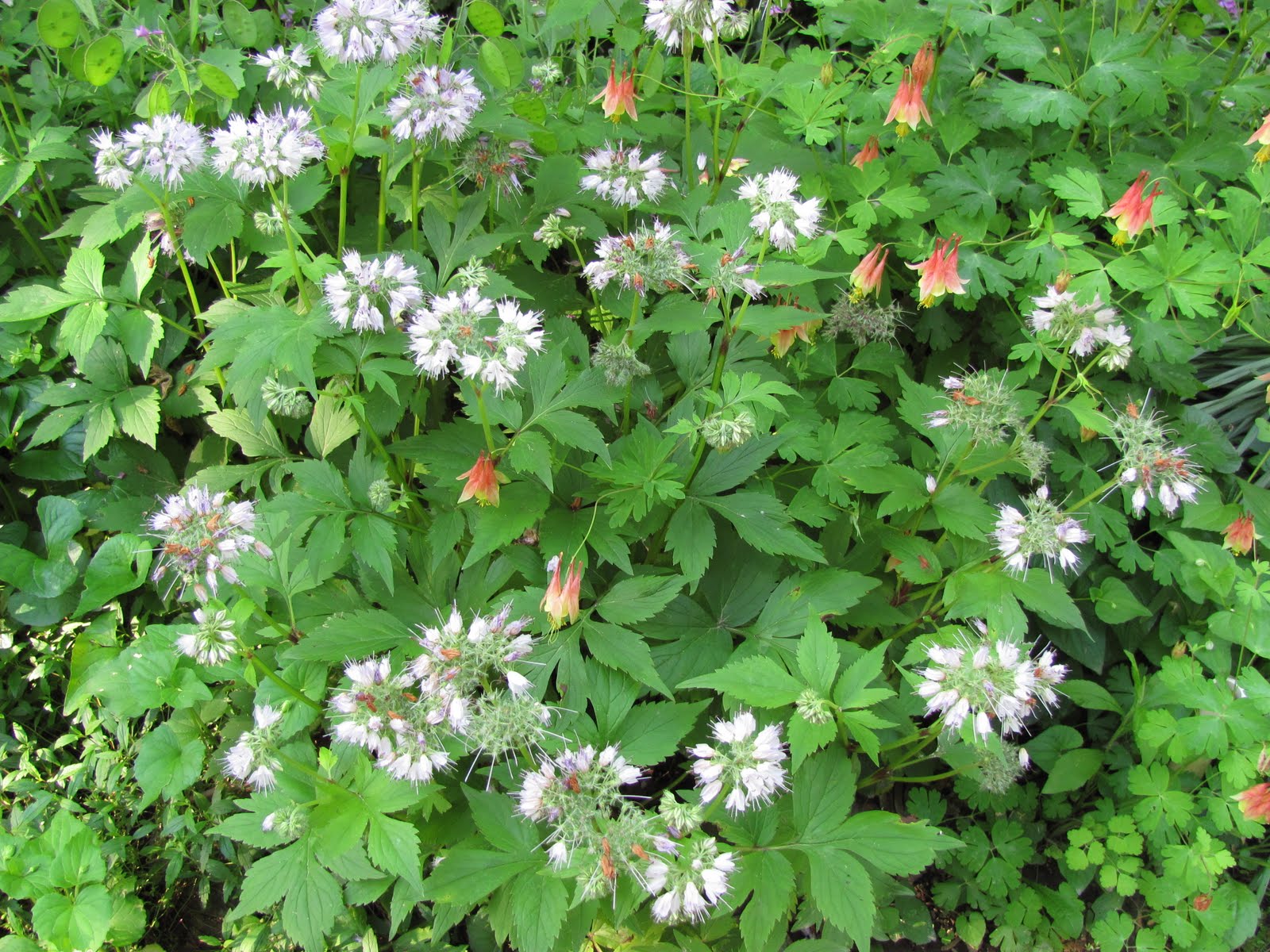
The last leaves of adder's tongue (erythronium) have disappeared for the year, and the path is open again. Part of today will be spent moving wild phlox out of it to a spot where it won't get stepped on. Wild ginger and ferns have almost completely covered another path and need to be relocated. It's still not too late in the season, and it's supposed to rain (again!) this weekend so that will be good for them. Butterbur (petastites) and giant solomon's seal that I moved last week are perky and happy already in their new homes with more wild phlox and ginger, surrounding a pussy willow and an old mock orange where only poison ivy and honeysuckle used to grow.

The cursed invasive Virginia waterleaf. Beautiful, isn't it?

Arum Italicum Pictum in bloom. You have to look under the leaves to find this huge flower!


I love the way this fern is opening up!


The woods has changed to summer dress. Some of this ginger has got to go! It will be transplanted to another area or donated to a friend's garden.

The moss along the dry creek is well established, in spite of the robins and brown thrashers. The woods is my favorite place to be. I often put aside my pruners and weeding tools and just sit on the old bench, listening to the birds and enjoying the serenity of this sacred space. It's the first place I go in the morning, savoring my coffee in the dappled sunlight, and the last place I visit at night when the air is cool and dim; listening to Nature speak to me in whispers of soft wind voices telling me deep secrets of the woods.

A visiting neighbor enjoys the garden too! Or maybe he just comes over for the petting.

A local resident out for a stroll among the violets.

Every day is an adventure in the Chaotic garden!

"Nature is a mutable cloud, which is always and never the same."
--Ralph Waldo Emerson


Thursday, April 8, 2010

Come take a walk in the Woods With Me


Grab a cup of coffee and let's go out to the woods! Redbuds create magenta bowers that beckon the way down the path, past the studio, under the pergola, through Virginia bluebells that make you careful of your step, and really look at what's at your feet. Stop and sit for a minute in the secret garden patio on the left, and enjoy the hellebores, celandine poppies, tulips and violets; and listen to the wind chimes.


Oh, look! A rare pink Virginia bluebell! I love it when Nature surprises us with her diversity!

.The mossy path is as soft as carpet under our feet. I love to walk barefoot on it!

A tiny fern has made itself at home on the edge of the path.
This new bed wll have hostas and a variety of astilbe, coral bells, tiarellas and ferns. The tall plants are surprise lilies ( Lycoris squamigera) that bloom in late summer. Behind this bed is a big colony of giant Solomon's seal (Polygonatum commutatum, var.), just coming up. A  young white redbud (cercis canadensis alba) is in the background. It is too small to see, but there is a baby redbud in the center of this bed, behind the big clump of surprise lilies. It will be beautiful in a few years. Redbuds are native here, and most of ours have planted themselves. 

A tangled mess of  Virginia waterleaf  ( Hydrophyllum virginianum) had to be eradicated here, but no fear, it is everyplace else in the wood. See that patch of green to the left and above? Yeeeah, there's more! The bright green area at the top right is yellow archangel ( lamium galeobdolon). It's beautiful when it blooms but really aggressive. Lets's see how long I allow that to stay there!  It carpets the ground under a huge hackberry tree and yellow twig dogwoods.


Woodland phlox has started blooming, and here is another stand of Virginia bluebells.  It is a beautiful morning and the sunlight slanting through the trees gives a ethereal light to the forest floor.
To the left and just out of sight, a bald cypress/dawn redwood cross (taxodium X zhongshansha Nanjing Beauty) will one day shade this area. A tiny Japanese maple (Bloodgood) is on the right behind the daffodils and a white dogwood is behind me. Another dogwood, Cornus Kousa, will be visible through the trees and to the left, as will an oakleaf hydrangea. This whole area (and most of the rest of the woods) was once a huge tangle of honeysuckle and euonymous that we have spent years eradicating and reclaiming. Woodsy perennials and shrubs (and more hostas, what did you think?) are planted here but this bed is only three years old and not filled in yet. Most of the perennials are still not up completely either. 

There are half a dozen dogwoods scattered through the woods also, but most are too young to bloom for a year or two yet.We have also planted  a catalpa, a witch hazel, an Arkansas black apple, elderberries, bird cherries, Tiger Eye sumac, a couple of viburnums, blueberries, pussy willow, buckeyes and nandinas as well as azaleas, both evergreen and deciduous. Privet, wild burning bush and bush honeysuckle were already  here, but seedlings need to be carefully weeded out to keep them from taking over. A huge mock orange is a remnant of the original owner, the only one left of a forest of them. The big trees are all native: hackberry, various oaks, black walnut, hickory and wild cherry.  At one time, this area was totally cleared, some 50 years ago, and a vegetable garden and orchard was here. The last of the apple and peach trees died in the late 1980's. Morel mushrooms still come up in the area where they were, in a good spring. None this year so far, tho!

This is the original wildflower patch that was planted (added to) some 25 years ago.Crested ireses, yellow adders' tongue, bloodroot, trilliums, toothwort, false rue anemone, woodland phlox, violets, wild ginger and a host of others make their homes here along with the mayapples and Solomon's seal.

False Solomon's seal (Smilacina racemosa) is up and will be blooming in a week. This plant was a native
here.

Dutchman's breeches (dicentra cucullaria) has colonized through the area. (I'm trying to remember to give the scientific terminology but I still love the old common names the best!)

Would you believe that this colony of Mayapples (Podophyllum peltatum) started with only three plants? Giant  variegated Solomon's seal is in the background.
 

Wild ginger (asarum canadense) and tiny woodsia ferns are a thick groundcover. Did you know that wild ginger root can be candied and eaten? It smells and tastes like tropical ginger but is very mild.

Gooseberries, remnants of the old garden patch that was here, bloom early and are a favorite of the bumble bees. Wish I could have gotten pictures of the bees, but I have an elbow bumper who likes to spoil my best shots. (See below)


Ras Tafari, king of the woods, companion, treat hog, lovable sometimes pesty elbow noser Abysinnian


 Shhh! Don't tell anybody you know where this is!! A friend gave us seeds of wild ginseng (Panax quinquefolius) a year ago last fall, and a few plants came up. We thought we had lost them in last year's drought, but I guess they just went dormant. Here's one! There are only a few so we are never gonna get rich off our 'sang patch, but it's fun growing them! It won't be harvestable for 5 or 6 more years anyway.


Crossing the dry creek. Mosses are getting well established, as well as lots of ferns and wildflowers. The dry creek is in its third year. It was all honeysuckle before then.

Four out of eight serviceberry saplings we planted along the edge of the woods last fall will bloom this spring, and they are all alive! They were transplanted from a bush near the house that was threatening to take over its entire bed. It is capable of making a grovefor itself.  Serviceberries are loved by the birds for the sweet, delicious berries (or so I'm told, but I haven't been able to get any of them! It was the first tree planted at Mt.Vernon by George Washington, and the berries are reputedly delicious in pies. If you can beat the robins. 

A side tip: to keep the robins out of your cherry tree, hang a wren house in the branches. Wrens don't eat fruit, and they are territorial little scrappers that will drive other birds away!

    The oak trees are blooming. The wind took down this  twig last night. Soon there will be a yellow haze over everything from the pollen.

I know there are purists who don't like to mark woods paths, preferring to keep them "natural" but after visitors to the garden persisted in wandering off  paths and tromping thru stands of delicate wildflowers, I opted for stones and fallen log edgings.
The cats are ready to go in to the Back Beyond, but that is for another day!

 Though the white lilacs beckon, my cup is empty and it is time to go back.


Thanks for joining me! I've loved visiting with you and sharing my woodland patch! I hope we can do it again soon!

Prairie Fire crab tree buds

"When I was a child, the woods was a magic place
Where acorn caps were elfin hats
And lilies of the valley were bells
that played for fairies to dance."--S.P.

Wednesday, March 24, 2010

Patterns and New Beginnings


The snow has mostly retreated from all the open spaces, but on the north side of the house and the stone wall, there are still drifts in spite of the 70 degree temperatures today. By tomorrow, there will be no sign left that the world was covered with a foot of snow just 3 days ago. It actually was good for the garden; since it has begun to warm up and the moisture has seeped into the earth, flowers have bloomed in just a few hours time. Weeping cherries, magnolias, redbuds and lilacs are all showing us a tease of their spring dresses. Forsythia and flowering quince couldn't wait, they have burst into full flower since this morning. Shade trees are lacy with buds, and the woods has a feeling of eager anticipation.

Weeping cherry
                                                                   

Magnolia soulangeana
                                                              
As the snow melts, I am seeing things that I have never before noticed. Not long ago, my attention was caught by a photo of, I think, bluebells planted in a river in the woods, and I wanted that effect. Not having access to all those thousands of bluebells, I thought to plant a stream of grape hyacinths, which do grow in my garden, literally by the thousands! Transplanting some wouldn't make much of a dent in the 60 year-old swaths of grape hyacinths under the forsythia, so I started it last fall, trying to follow a natural path in the woods, but I couldn't quite see where it should go. Not to mention that it was difficult to find the bulbs when they weren't up. Watching the snow melt this spring, I saw the pattern through the trees, exactly where to follow the lay of the slope. Grape hyacinths are easily transplanted in the spring, even in full bloom, so I am going to work on that in the next couple of warm days. It may take two or three years to get the full effect, but I have patience.

      
Follow the snow trail to the left,and imagine this to be a river of blue blooms! Flowing around the   
young Kousa dogwood in the center of the picture, and down the slope to the bottom of the hill.

Other patterns begin to emerge; when the ground is somewhat bare of foliage it is easy to see where new beds should go, where curves could be made more pleasing to the eye, and in my mind's eye, where plants would give the best effect if I moved them around a bit. Some of my plants spend more time on the end of a shovel than they do in the ground, I think. I have planned a big new hosta and shade bed, where the Virginia waterleaf was removed last week. It has all been nicely dug and prepared with a thick layer of compost, and I spent most of the afternoon planning where the new plants should go, sticking labels in the soil to mark the spots and planting the bare root ones I have already. It is bordered on one side with a mossy path, and on the other with a huge patch of giant Solomon's seal. The whole thing is shaded with a black walnut, and I have left a 2 yr old redbud as an understory tree in the future. I have also left surprise lilies (lycoris) and a few purple violets.  

On the other side of the tree are Jacob's ladder, ferns, wild sweet William (phlox divaricata), a hellebore, a "Paul's Glory" hosta, and here I have spared a few of the Virginia waterleaf. (I may be sorry later!) It is edged with crested irises, ajuga, yellow wild violets and strawberry begonia (saxifraga stolonifera). There are also daffodils scattered about the whole area, and trout lilies transplanted from the lower part of the woods.Stepping stones and a birdbath separate this area from a whitebud (cercis canadensis alba) surrounded by honesty, more daffodils and other spring blooming bulbs, and a colony of Virginia bluebells. This whole area is all part of more extensive plantings that lead down the hill into the woods itself, getting more naturalistic as it goes deeper among the trees where the truly wild things live.
I've left plenty of room for the plants I've ordered, but they won't be here until late April or May, which somewhat distresses me. It usually gets pretty hot here in the Ozarks by mid May, and most perennials should already be in the ground and growing by then, but no one will ship this early to my zone. By mid May, most of the spring bloomers have come and gone. There seems to be a "window" of planting for spring wildflower perennials here, about 3 weeks between mid-March and mid-April, and if it is missed, sometimes they have a difficult time getting established.

Tomorrow I will also be transplanting wild ginger, woodsia ferns, Virginia bluebell babies, hellebore seedlings, trilliums, wild phlox and Jacob's ladder into areas that we've cleared of Japanese honeysuckle and wintercreeper euonymous. I've been doing that for the last couple of years, and they are carpeting the woods floor nicely.

April, 2009

 I also have elderberries, which arrived in the mail the day before the snowstorm, and blueberries to plant in the sunny edges of the trees. We probably won't get any fruit from anything. The birds and animals snap up all the gooseberries and serviceberries that grow here, but at least I will have the flowers. I planted an apple tree for the same reason--because I love the flowers! I expect I'll have to cage them until they get established to protect them from the deer. We planted a row of serviceberries along the edge of the woods last fall, and every one is leafing out this spring. They were suckers from a established bush closer to the house.

Part of my day was spent checking out the nurseries and garden centers in the area, and tho a couple of them don't have any new spring plants in yet, I didn't come home empty handed! I've been lusting after Invincibelle Spirit hydrangea, the pink Annabelle that is being promoted to help fund breast cancer research;  http://invincibellespirit.net/ and I bought one today! Not only does it promise to be beautiful, money raised from the sale of it will help this critical research. This is a cause very close to my heart as I have lost good friends in recent years from breast cancer and several other friends are survivors. If you have room in your garden, please consider Invincibelle Spirit.

I also picked up a wintergreen, gaultheria procumbens; a good woodsy groundcover, and another hydrangea, mycrophylla "Pia", which only gets about 18" tall with pink blooms. It should be pretty in the new hosta bed.

More planting tomorrow!

Grendel, soaking up some sun!