Showing posts with label trilliums. Show all posts

Sunday, March 2, 2014

A Native What?


Native is the buzzword in gardening these days. We are urged to plant native, even to the extent of digging up our “ornamentals” and replacing them with native plants that “our” insects and birds love.

But the definition of native is often pretty vague. While I do agree with growing locally native species, it is hard to know just what they are. A true native plant is one that grows in the same habitat in which it originated. It can be native to a continent, a state, or a region. So what is that?  Just because a plant was here when settlers first came, does not mean it “originated” here. Seeds are blown on the wind, carried on tides, in rain, or dropped by migrating birds, which is partly why many of our “natives” are also native to half the rest of the world.
“Native” can be one of the most confusing terms out there for the casual gardener.  Is a plant ok to grow because it’s native to the North American continent? Not necessarily, natives to the East Coast could go nutso in a zone 7 or warmer garden and try to completely take over where cold winters don’t keep them in check (ask me about Virginia waterleaf). Or wither and die because the climate is too hot, dry, cold, wrong altitude, etc. It takes a lot of research to determine which plants are actually native and which have been here so long that like humans, they have evolved, adapted and become naturalized. Though some non-natives truly aren’t suitable to native insects and birds many do provide nectar, habitat and food for them. You see as many wasps, flies, bumble bees and honeybees buzzing around a stand of non-native sedums, for example, as around a patch of goldenrod.

Oh, wait, honeybees aren’t native to North America.  

Food that our birds can eat? Fruits, seeds, nuts that they are used to? Sure. But remember that many of the birds that live here in summer are not “native”, either. This is their summer breeding ground, and they are only here for a few short months until they return to their Central and South American habitats, where the food they eat is unfamiliar to us.
While many native plants are beautiful, many are not suited for small, suburban gardens. They tend to spread with exuberance, look weedy, and as they should go to seed to keep them going year after year as well as providing forage for birds, also look messy and untidy. To gardeners who like to keep things neat, this might be unacceptable.  If you don’t have a big garden where they can grow in sweeps and swaths, you can still plant natives, but limit planting them to those which don’t spread aggressively. Many native shrubs sucker and make thickets of themselves, and while we all admire sassafrass, shrub dogwoods, native viburnums, sumac and others, most of us don’t want to spend all of our gardening time cutting out the suckers to keep them in check or pulling out  all those seedlings, or give up all of our garden room to them. We need to plant natives with caution, just as we should with imported plants. Some of them should just be enjoyed in their natural setting. 

Bidens, or beggar tickseed, is a native annual that is definitely not for the small garden.
It is true in many cases that many non-natives can crowd out and replace our native species (though anything that can crowd out and replace ragweed is a good plant, in my estimation) and those plants should be responsibly eliminated from your garden. But even some natives will do the same if the environmental conditions are right.

White trillium, a beautiful woodland native to grow. Naturalizes nicely, not invasive.
 
We grow lots of natives here at Chaos. Some have been mistakes that we are trying (with little success) to eradicate from our garden where they crowd out other less aggressive natives that we really want. Violets are one of the best examples I can think of, though they were here before we were. Beautiful and loved in verse and art, they spread with such exuberance that they quickly become a nuisance weed. In this garden they have even over-run lily of the valley. That aforementioned Virginia waterleaf makes thick mats of tubers that choke out other desirables. I understand it is endangered in some East coast areas. I would be glad to send them all of mine. Mayapples? Solomon’s seal? Native ginger? Cattails, or heaven help us, horsetail fern? I do have horsetail in my garden, but it is in a barrel water garden in a pot where it can’t escape, because it could take over the known world with a good running start. Native to half the world, including the US, it is not a desirable garden plant.
Many natives have hybridized with imported plants over the last few hundred years to the point where it is impossible to separate the taxonomy, and have become an integrated part of the biodiversity of our continent, as impossible to eradicate as the earthworm, which is not native here, either.
  
In many cases, non-native plants are so heavily into our culture and economics that we could not do without them. Peaches (native to Asia), apples (Kazakhstan), European grapes, oranges (China), cotton (Central America), beets (Mediterranean), tomatoes  and potatoes (South America), soybeans, wheat (Asia, Middle East) and a host of other fruits and vegetables come to us from all over the world to be grown in our  farms and home gardens. Many of the food plants from Central and South American came to North America via early native traders and were already here when early European settlers arrived, so we think of them as native. And, those honeybees! Not a plant, imported from Europe, but who wants to do without them? They are an important part of our economy.  If not for honeybees, what would pollinate all those imported food plants?
So where do we draw the line? Purists would have us grow nothing but natives, but who wants to give up their vegetable gardens? And what about all our native wildflowers that the Europeans “discovered” here, took home and hybridized into myriads of cultivars to sell back to us—are they still considered “native” because they originated here? And I guarantee that I am not giving up my daffodils, crocuses, tulips and hyacinths. I think we can find a balance of native and non-native plants, and our gardens are richer for it, just as our country is rich with a mixture of peoples from other cultures. Diversity is my buzz-word. There is room for a lot of that, taken responsibly and in moderation.
  
Natives and exotics co-exist happly here

The point is, we have to use as much common sense planting natives as we do with planting our beloved imports. Many non-natives are not aggressive, such as hostas, and co-exist beautifully in our gardens with no real threat to our environment. I grow mine with native trilliums, mayapples, ginger, dog-tooth violets, ferns, columbines, bloodroot, and a host of other woods wildlings. I do find that growing some natives is a lot more work than my other perennials, just keeping them in check. 
Be sure if you plant natives, you have room for them to spread, because they will, exuberantly.

But for all the exotics I grow, there is also such a huge population of natives that no animal, insect or pollinator goes hungry here and our garden teems with wildlife. It seems to be in pretty good balance as I seldom have a problem with anything except deer and mammals which, because of human population growth, have lost many of their predators. much of their environment and are forced to live in our back yards, but that is another issue.
Get a good book on North American wildflowers, one that is written for your area, make lists, research anything you are thinking about planting, and if anywhere in the plant descriptions are the words “colonizes well”, “spreads easily”,” reseeds well”, or “good for naturalizing” consider whether it is right for your garden, native or not. Look up invasive plant lists to determine if a “native” is invasive in your area. And yes, read Doug Tallamy’s book, “Bringing Nature Home”. It is an eye-opener.

A good source for information is the Chicago Botanic Garden’s research program: http://www.chicagobotanic.org/research/plant_evaluation/.


And Cornell University has a great site about growing natives: http://www.cornellplantations.org/sites/default/files/Native.plants.Seed_.workshop.pdf

Monday, April 12, 2010

Fertility Rites, Going to Seed and What a Difference A Day Makes


Spring is a wanton, wild, virile, fertile time of the year. Sex is everywhere. Birds are mating, nesting in every available tree and shrub.  Butterflies are emerging from over-wintered chrysalises, bees and wasps are pollinating everything in sight, and squirrels are chasing each other in wild leaping abandon across treetops and over roofs. Frogs and toads are singing, full of it, until every square foot of water is full of gelatinous ropes of eggs, and black with tadpoles and polliwogs. And the flowers! They are ALL about sex, flaunting their spring wardrobes, their only be-all for existence to make seeds,to fling them to the winds and chance, spreading their kind far and wide. Many of the spring flowers haven't wasted any time, either! They have already bloomed and are ready to send out seeds to conquer the world, one at a time!

Bloodroot (sanguinaria canadensis) almost at bursting point, looking out for new territory

Celandine poppy, (Stylophorum diphyllum), getting ready to claim new real estate

Daffodil seed pod--planning for the future, 5-6 years from seed to bloom! They also increase by division of bulbs, but the seeds get scattered at quite a distance and start new clumps away from their parents.  Sometimes one old clump will have neary a hundred bulbs! (background leaves are false Solomon's seal, smilacina racemosa)

This is kinda fuzzy! There are hundreds of these, adder's tongue, (Erythronium Americanum) on the march to cover as much new ground as possible, both with seeds and division of bulbs. ! Here's another that will be several years from seed to bloom; making huge colonies of plants with single leaves, that only show themselves for about a month in spring until they disappear until next year.

Hellebores have their seed pods set already! This is Helleborus Niger, the so-called Christmas Rose.

Something seems to have changed in the woods this year. More exuberant, maybe, surely more fertile. I think the woods has undergone a change in dynamics.I'm not sure just what the cause is. Possibly climate change, perhaps it's the rooting out of all that honeysuckle that used to cover nearly every square foot of the ground except where the wildflowers grow so closely interplanted that not an inch of ground shows between them.
Yellow corydalis, ( Corydalis flavula) "colonizes nicely" as they say in the seed catalogs, but it is a dainty, ferny plant that is always welcome wherever it shows up.  An old name for it is "yellow fumitory".

Or perhaps it was the dry creek and re-routing of major paths. Whatever the cause, and maybe all of the above; as I work around pulling weeds, small trees and honeysuckle bits that I've missed, I'm finding all sorts of small wildflower seedlings where there were none before. Some are more than 50 ' away from the original
stands; bloodroot, trilliums, dutchman's breeches, ginger, virginia bluebells hundreds of feet from any other colony; even tiny woodsia ferns barely an inch tall.  One hellebore seedling somehow found its way down to the bottom of the woods. It seems with the honeysuckle gone, all these plants have the freedom to go exploring and stake out new territory! I must be careful where I step so I don't crush these baby colonies. I love to see them spread like that! In a few years, they will carpet the entire forest floor.

I have planted masses of lysmachias,(two kinds), Virginia waterleaf, common daylilies and a chrysanthemum that reseeds as well as spreads by stolons, in the bottom of the woods, all together. I'll let them fight it out for territory as they are all greedy and aggressive claimers of property. If they can live together it ought to be a colorful spot! There's nothing else down there for them to crowd out except a few irises, so we'll see.

What a difference a day makes!

There are surprises every day in a spring woodland garden! As I wander around down there peeking under leaves and and peering around trees, I find all kinds of things that weren't there yesterday.
White trillium (trillium grandiflorum) I always look anxiously for these as they come up later than the other trilliums, but they always come back, and sometimes there is a new one where there wasn't last year!

Yellow trillium (trillium luteum)

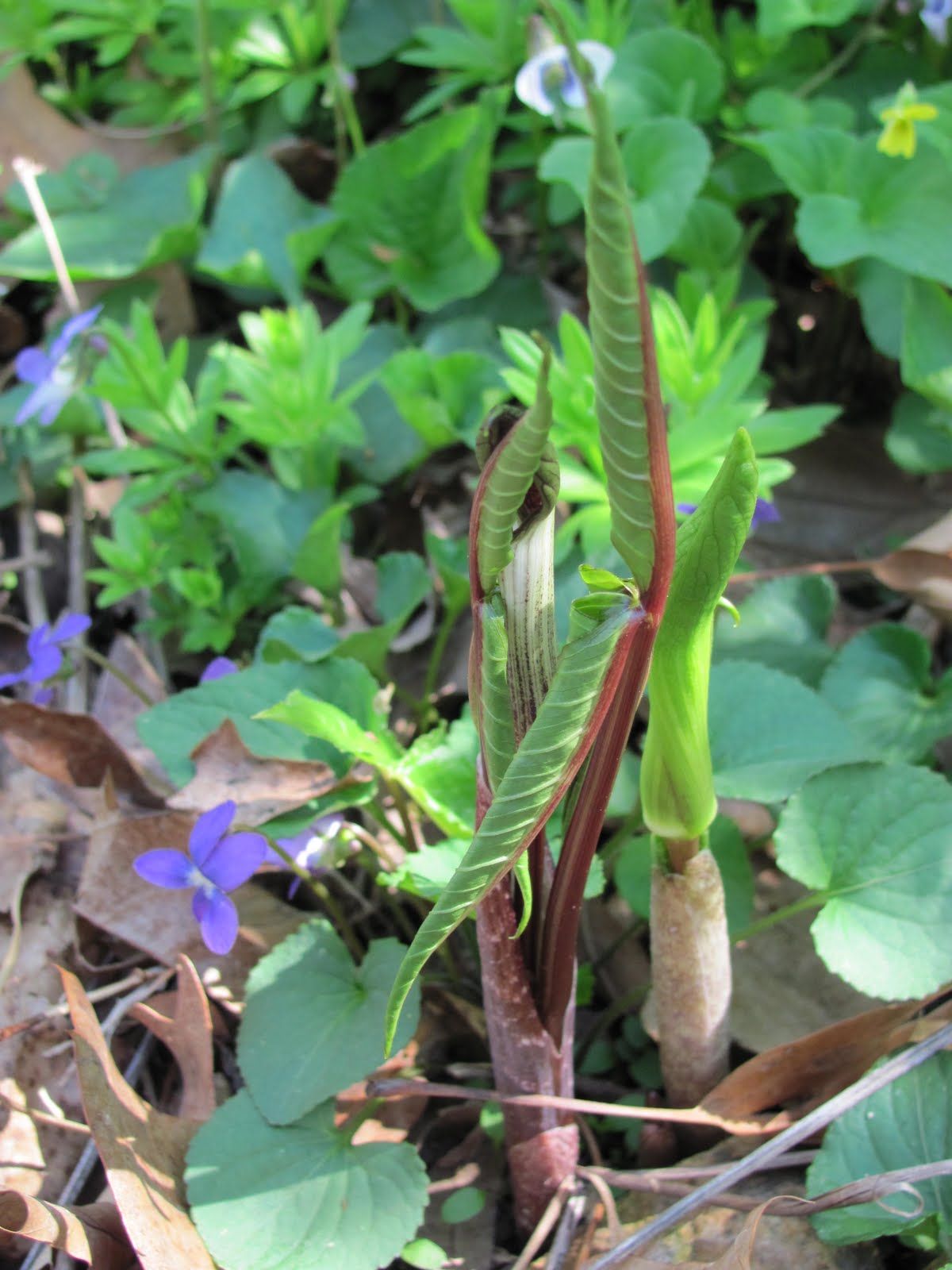
Here comes Jack in the pulpit (Arisaema triphyllum)!


One of my favorites, hardy orchid (bletilla striata) in bud. They will be blooming next week.

The deer ate the first flowers of pasque flower (anemone pulsatilla) but they put out some more! I covered them with an up-ended flower pot tonight as the deer were lurking in the meadow Out Beyond waiting for me to leave so they could have their way with my plants! I guess the clover and lespedeza that grow in the meadow aren't tasty enough for them.

Merry bells or bellwort (uvularia)

Bird's foot violets (viola pedata), one of my favorite violets. This violet is a prairie plant and loves full sun.

Jacob's ladder (Polemonium) I wouldn't be without this pretty, dainty blue.

Tritellia (lpheion uniflorum) This is a little bulb that will spread willingly and wantonly, and last for weeks in the spring garden, well into May. Its beautiful blue flowers seem to glow in the dusk.

Woodland phlox (Phlox divaricata) Can be any shade of blue, sometimes pinkish or white. Strongly perfumed and blooms for a long time. Lots of cultivars but they still mostly look just like this wild one!

Flowering almond (Prunus glandulosa) Wonderful flowering shrub! The one that grows here came with the garden and is probably 10' across.


Viburnum Carlessi Korean Spice. Can't you just smell this? Wonderful!

Combine this old-fashioned lilac with the above viburnum and it is fragrance heaven!

Praiie Fire crab (Malus "Prairie Fire") Today it's in bloom! 

What is tomorrow going to bring? I can't wait to get out in the garden!

"With fields full of clover and the apple trees,
The rosy richness of a springtime breeze,
I forgot all the work I'd planned to do
And just loafed in the meadow till
The day was through."
--Edna B. Hawkins

Saturday, March 20, 2010

Keeping the natives under control

As much as I do love the native plants, I have learned over the last 25 years that all things must be kept in moderation. After spending all yesterday ripping out a huge patch of Virginia waterleaf (hydrophyllum virginianum) that had gotten totally out of hand--and by no means did I get it all, there are still great drifts of it--(that stuff is endangered in some areas? Really?) it was once again brought home to me that messing with Mother Nature is not to be undertaken lightly, or you may regret what you have wrought. I planted a couple of those plants in my woods about 20 years ago, and for years, it grew to be a nice, flourishing, pretty little patch, lovely spring blooms that the bees love. And then, little by little, it began creeping, then leaping. First thing I know, it's invading the ferns, shoving in among the hellebores, pushing aside the Jacob's ladder, popping up in the middle of the hostas, choking the lilies to death and swarming across the paths and making itself at home in the perennial beds. Besides being rhizatomas, making huge, solid, impenetrable mats that take a mattock to pry loose, it spreads by seeds so no telling where it will turn up. At least 50 feet away from the original patch. I moved a lot of it down to the bottom of the woods where it can spread to it's heart's content without making it's neighbors miserable and I will be working diligently to get it out of all the other areas where it has settled down. I do love it, but enough already!

That said, and while we are on the subject of  planting native, which I fully endorse, a little common sense and observation of nature is in order before you begin. If you see huge drifts of say, Queen Anne's lace along the road, or sweeps of black-eyed susans in a field, that will give you a clue of how they behave when they get established. I have them both in my garden, and usually I try to dead-head them before they go to ripen, leaving only a few to reseed. Some plants can reseed all they want without causing a real problem, like the columbines, of which I don't think there are ever enough, and woodland phlox, which is easily moved if it spreads too far. Spring ephimerals, like trout lilies, trilliums, Virginia bluebells, bloodroot, and hepatica, which belong in a shady woods setting anyway, where they won't be disturbed, can spread all they want without causing a problem. Mayapples, violets, certain ferns, and solomon's seal, beautiful as they are, should not be turned loose in a garden border unless that is all you want to have in a few years time. Native plants are like wild animals; beautiful, sometimes elusive, and we all want them for pets, but they can be terrible and not at all able to be domesticated!  There are many wonderful cultivars of  wild plants which ahave been bred to make good garden plants, and if you want a reasonably tidy garden, those are probably the ones you should seek out. If going totally native is what you're interested in, then neatness in a garden is probably not your style.  Growing native can be a lot of work!

You should also be careful what "native" plants you go for. Learn what is considered a noxious weed in your state, such as Canada and Scotch thistle, some varieties (or all) of lythrum, kudzu, multiflora rose, among others, and also know that they are NOT native plants, but like Japanese honeysuckle, have been imported and are vicious invasive marauders, and in some cases, it is illegal to grow them. Also, some true natives are considered rare and endangered (like the Virginia waterleaf) in some states and may grow prolifically in others.

Knowing your zone is also important. There is probably no way to grow ferns from the Pacific Northwest, in Missouri (ask me, I have tried), or desert sage in North Carolina. What you should look for are plants that are native to the area in which you live. Not only will they look natural in your setting, you will not be introducing a species that might go hog wild and try global domination in your good soil conditions that they wouldn't get where they normally grow. Or, just die because you don't have cool nights, or hot enough days, warm enough winters, too warm winters, or the elevation is wrong.
You will find that there is a lot of overlap between zones, and many wildflowers and lovely natives that grow in Minnesota or Canada will grow as far south as zone 7, possibly 8.  

But regardless of their zone, you probably cannot grow saltwater beach plants in the Ozarks, or freshwater swamp plants on the oceanfront. You need to give them the kind of soil and growing conditions they have in the wild, in order to be successful. But always take with a grain of salt what the books tell you; e.g. those Virginia bluebells? Books say they need moist, cool woodland soil. In my Ozarks plateau woods, they are happily making well-established colonies in rocky, dry soil in our hot summers, reseeding themselves in the gravel paths, between stepping stones, and in odd corners everywhere. They do go dormant in the summer, their beautiful blue bells only a brief spring show, so they never get to be a nuisance. Others, needing a lot of shade in the wild, may grow very well (too well) in part sun if they have extra moisture.

You just can't have them all, nor would you want them in a lot of instances. So do your research, choose wisely, grow native, and enjoy!