Showing posts with label frogs. Show all posts

Monday, March 17, 2014

Time for the Spring Serenade!


A male cardinal in the lilacs keeps announcing how “pretty, pretty, pretty” he is, while close by, his busy mate is paying little attention to his posturing. Just a single pair or two claiming territory here is all that remains of a huge flock of cardinals that crowded our feeders through the snowstorms. The long cold fingers of winter are gradually being pried loose by a gentle but persistent sun, and the soft, moist air smells like new life.

Soon spring peepers will be calling in the pond, looking for mates and laying long, gelatinous strings of eggs that will hatch into tadpoles and polliwogs.

The pond has to be cleaned this week before they arrive so their eggs don’t get destroyed in the process. Tadpoles are good citizens in a pond, eating algae which helps keep the pond clean, while providing food for winter-starved goldfish and koi until they get too big. When they have matured, baby toads scatter through the garden, tiny eating machines that munch bugs and slugs as they grow. We need all the toads we can get as they are the first line of defense in plant protection here at Chaos.


Our pond is about 8’x 15’ and some three feet deep in one end, which is deep enough for koi should we choose to keep them. There were beautiful butterfly koi and fancy goldfish a few years ago, until a marauding raccoon cleaned them out. We haven’t replaced them since, just stocking the pond with feeder goldfish from the pet store in recent years. They grow fast and live a long time, if the raccoons don’t come back for lunch; but if they do, at least we won’t have provided them with an expensive gourmet feast.
I’m not sure yet if there are any fish alive in the pond this year. It might have frozen solid to the bottom with the intense cold, possibly too much for even the cold hardy goldfish. I do hope the leopard frogs that overwinter in the muddy bottom have survived.

The pump was turned off last fall as there is a leak somewhere that kept draining the pond at the rate of 6” or so a week. We couldn’t find it in the pond liner, so the waterfall will have to be dismantled to see if that is where the problem is. Possibly roots from our Crimson Queen Japanese maple growing are through the liner somewhere. 

While the waterfall is torn apart might be a good time to put in a better filter, if we ever decide to try koi again as they need more oxygen in the water than do goldfish. A long-handled leaf grabber made for picking up leaves behind shrubs and flower beds also makes short work of leaves and pond debris, except for what settles to the bottom, but we don’t worry too much about that. A little mud on the pond bottom doesn’t hurt anything, while providing habitat for water insects and little organisms that fish and tadpoles feed on. About every 5 years we drain it and clean it out when it builds up too much.

It’s going to turn green for about four weeks, that’s the nature of a pond. In winter, warm water settles to the bottom, where fish hibernate during cold weather. In the spring, the pond “flips” which means that the warmer water rises to the top and colder water settles to the bottom. As sunlight enters the water, it causes algae to “bloom”, or grow, which can turn water pea soup green. Fish don’t care, but most pond-owners hate it as it isn’t aesthetically pleasing.  The usual reaction is to drain it and refill with fresh water; but that is exactly the wrong thing to do as it starts the algae blooming process all over again with fresh nutrients for algae to feed on.

If your goal is instantly clean water, there are chemicals to kill floating algae and settle particles, especially if you have koi as they eat plants, root in the bottom like the finny pigs they are, and can generally make a mess of a pond. We prefer to do without most of the chemicals, letting plants help achieve that natural equilibrium as they grow, but until they do and begin to shade the water, it is going to be green. Patience is the word here. Besides, I like to save my money for important things, like more hostas, and chocolate.
Keeping 40-50-% of the water surface covered with plants prevents sunlight from reaching into the water, thus starving out floating algae. Annual floating plants like water hyacinths and water lettuce provide shade, and are also natural filters, their roots catching and holding debris which would otherwise make the water murky. Oxygenating grasses float under the surface, also blocking sunlight. Water lilies and lotus shade the water with their big leaves. A coating of a beneficial algae that grows underwater on the sides of the pond also helps keep water clear of the floating kind. A small bale of barley straw helps keep the water clear of filamentous algae; long stringy stuff that covers everything.

 When fresh water is added to top off the cleaned pond, we use a dechlorinator which neutralizes the chlorine, chloramines, and heavy metals present in city water that will kill fish if not treated.  A preventive dose of fish medicine as well helps promote fish health.

We cleaned out our little woods pond also, where the wild things come to drink. It was full of leaves, the raccoons have eaten the fish, but there were water hyacinths  and a water cypress with a new shoot still alive, buried under two feet of leaves! Amazing!


Look who I found in the woods pond! This little leopard frog was cold and sleepy and not moving much but alive and well!

I can’t wait to open my windows and listen to the spring peepers in the clean pond as they sing me to sleep at night. Then I will know spring is truly here.


"The music of all creatures has to do with their loves, even toads and frogs."--Henry David Thoreau


Monday, March 29, 2010

Is It Art in My Garden, or Cute, Kitschy or Trashy? Recycled, or Junk?


As if plants aren't art enough, many of us have an overwhelming desire to put objects in among the foliage and flowers. For some, it's gnomes, plastic flamingos, cutesy painted stuff ala Mary Englebright; for others, it's statuary, birdbaths, Japanese lanterns, gazing balls. There are folks who like things like bowling balls, bottle trees, various rusty old farm and garden machinery, old tools, even an old pickup or two (just kidding--or not!). Avid flea market hunters dote on old painted lawn furniture, vintage rakes, plant stands, antique gates and even weathered wood tool sheds. I have a friend who actually drug home an old boat that she used as a fish pond! People bring home all kinds of crafts and souvenirs from trips, craft fairs and amusement parks and display them in their gardens. Any of a thousand mail order catalogs sell cute garden animals in all sorts of poses, tree "faces", signs, stepping stones, lights; just about anything somebody's imagination can conceive will appeal to somebody. Big box stores are full of things; gift shops and garden centers appeal to our senses of amusement, amazement, and the "aaww!" factor with an astonishing array of garden "art" accessories.

Then there are the artists and crafts people, who create their own works and display them, often for sale, in their own gardens and public gardens as well. Books have been written about them, describing pieces as "quirky", "a sense of style", dreamlike imagery", exuberant", "funky". Just like in a  museum, art pieces in a garden tend to have descriptive phrases attached to them according to how "outre" they are in character, which can range from the elegant to the plain trashy, depending on the eye of the beholder. 

There are gardens which are works of art on their own. Japanese gardens, with their own sense of style, rely on stone, mosses, pruned and trained plants that are sculptures in themselves, with rules of placement that are sacrosant, in traditions that are centuries old. Topiary gardens are living examples of garden art, and modernist gardens rely on architecture as much as they do on plants. Creations of some landscape gardeners are as much art as any object carved of stone, wood or cast in bronze.

I, for one, and for a lot of people I know, (possible influenced to some extent by the many garden books and magazines I've read) tend to be more or less eclective in collecting objects for my garden. I also belong to the generation of "use it up, make it do", which, combined with my artistic sense and love of shapes and textures, puts me somewhere between the scavengers, the flea market crowd and the artists. I love to create, and my garden is as much a creation as the objects d'art (laughingly) that I decorate it with.

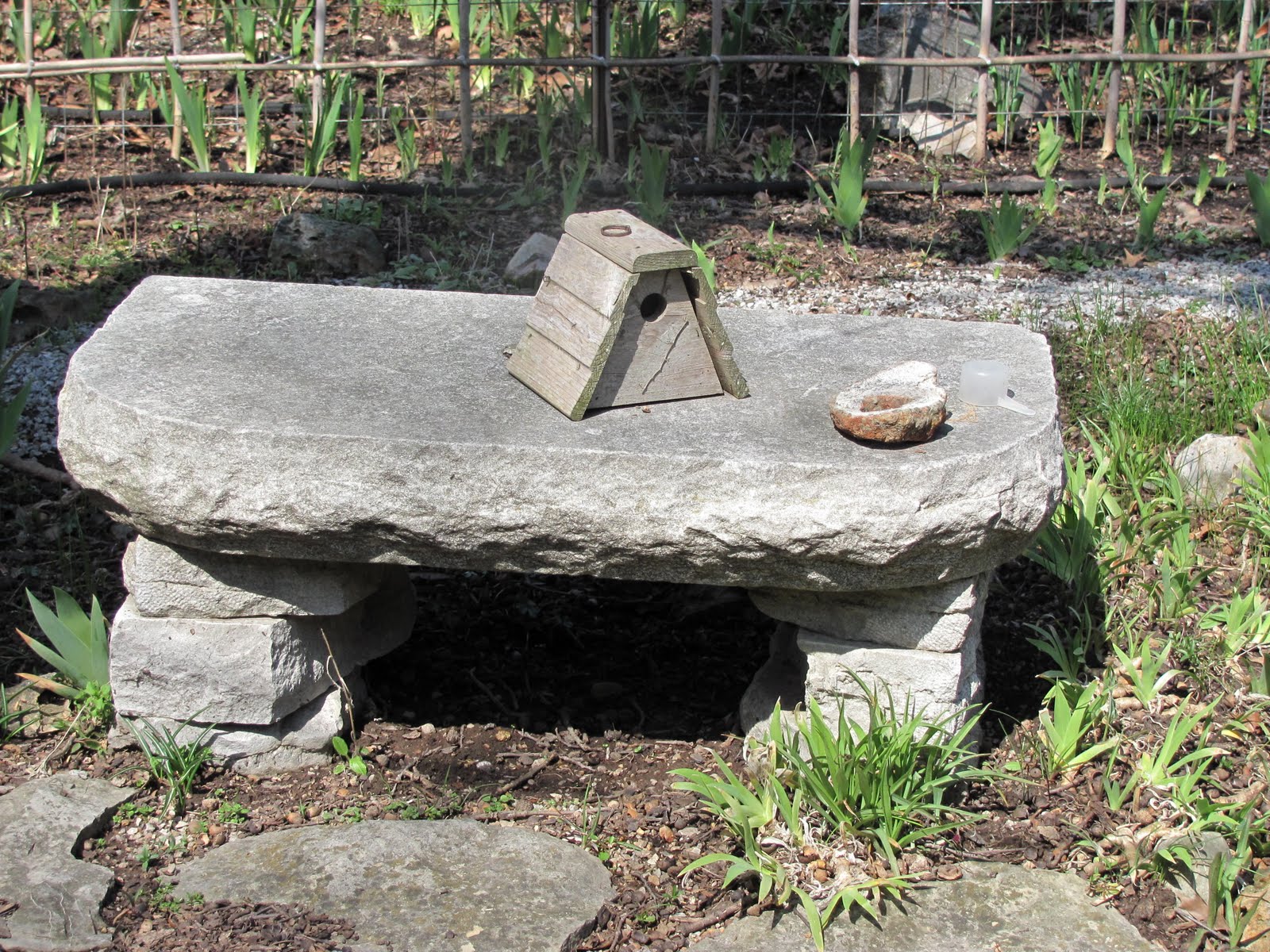
Part of "art" is a sense of fun, but just as important to me is placement. We have all seen tiny front yards populated with dozens of yard ornaments that outnumber the flowers, making you wonder however those people manage to mow the lawn!  Though I recycle and create any number of things for garden use, they aren't on display like a group of whatnots on a shelf. Among all the plants and flowers, you come on many of them like little surprises.  My dry creek is populated with a collection of frogs that you have to look closely to notice. A small collection of lizards hangs out here and there among the wild flowers and trees; you might not see them until they are right in front of you. A pair of vintage, lichen encrusted benches await you by the paths in the woods, and just for fun, a trio of tree branch "sculptures" resembling nothing so much as a family of Ents marching through the trees. These replace a group of huge grapevine balls that rolled about the wood as the wind took them, a few years ago.


Closer to the house, in the daylily garden just off the deck, there is yes, a bottle tree! I found myself fascinated with the lore of them last summer, and had to have one! This one was made with a branch taken down from an oak tree by The Ice Storm of 2007, as we remember it around here, and blue bottles were collected over the winter. I enjoyed emptying some of Riesling; others came from friends and the local recycling center. It spent the winter on the deck but is now in its more or less permanent place surrounded by daffodils and red Greggi tulips which have yet to bloom this spring.


I do have fun with recycling and repurposing things, too. Old rusty kitchen graters become candle difusers, twinkling like fairly lights after dark. Clay drain tiles standing on end and filled with sand also hold votive lights (citronella in the summer) when we have a garden party.


A discarded fireplace insert becomes a patio fireplace; a huge cedar stump topped with a flat stone becomes a garden table.


And I do love vintage plant stands! One is topped with a vintage floor grate. A discarded fire hydrant fitted with a waterline and faucet bib helps keep the herb garden watered; 1940's era metal chairs provide comfortable seating throughout the garden. An old round galvanized tub with a liner and an antique pump (non working) holds a purple taro and water hyacinths, and a real frog or two in the summer. A garden table is made with a concrete top that was poured into an old barrel ring (a project with my granddaughter when she was 8), decorated with tiny heart-shaped ceramic tiles, and supported by three left-over clay drain tiles.


The Yardbird was inherited.


 Various vintage tools and found things decorate the tool shed and studio, and hang on the fence that separates the back yard with the beginning of the woods gardens.


Small logs from trees that either fell in The Ice Storm or were thinned out of the woods make a rick-rack fence along the woods, and a rainbow of irises lines the roadside.


A limestone bench came from a porch that was being dismantled; our driveway/parking area is constructed of concrete slabs from our own front porch that was broken up when our house was remodeled. (see above behind the patio fireplace) It also provides extra seating when we have a large garden party! A pair of huge planters recovered when a fast-food restaurant was re-landscaped (my husband was the landscaper and hauled them off) are filled with chrysanthemums that spill over the sides in the fall. A fancy old child's bed iron headboard becomes an herb garden gate; a piece of concrete architectural salvage found by the side of the road becomes a birdbath base. And of course, being Airstream owners, (kind of a weird little quirk we have) there have to be plastic flamingos somewhere, and there are, by the pond among the irises.

No garden would be complete without a toadstool. This was once a garden light.

Art, as they say, is truly in the eye of the beholder. 

 A couple of my favorite books: "Artists in Their Gardens" by Valerie Easton and David Laskin; and "Garden Junk" by Mary Randolph Caarter