Showing posts with label transplanting wildflowers. Show all posts

Wednesday, March 30, 2011

Balmy Breezes, Shivery Freezes and Rainy Days


The magnificent flowers of Tulip Magnolia (magnolia soulangeana) are sometimes lost to a late frost--but not this year!
                                                  
March never can seem to make up it's mind. It starts out in the morning shivering in a winter coat, and by noon it's shorts and a tee shirt. Two hours later and you're drenched in a sudden downpour, mixed with 3 inches of pea-sized hail and wind that litters the ground with thousands of tiny twigs and branches, usually just after you've just picked  up all of the debris from the last weather snit.Then the sun peeks out; Mother Nature laughing at her own perverse sense of humor (Not Funny, Mom!) and warms your body and soul , kissing you with fresh breezes and hugging you with the delicious scents of fresh flowers and moist earth.

Miniature daffodils
                                                                    
Tritellia, one of my favorite small spring bulbs
                                              
Peppermint stick (clusiana) tulips
                                                                 
The next day, you wake up to a skin of frost all over everything, the daffodils are shivering and the rhododendron leaves are curled up into slim fingers that makes you want to fit them out with mittens!  There's a promise of 70 degrees by Sunday, but.....are the promises going to be kept?

Butterbur (petasites) flowers come up before the leaves
                                    
Vinca minor atropurpurea with white grape hyacinth

Spores on moss

Woodland walk
                    
Hosta montana aureomarginata
                                                       
Lots of promises to keep.

"And time remembered is grief forgotten,
And frosts are slain and flowers begotten,
And in green underwood and cover
Blossom by blossom the spring begins."
--Swinburne


Tuesday, June 29, 2010

Going Native: Plants of the Prairie


There is so much talk about growing native plants these days: what is native, what isn't, what are weeds, what can be called "wildflowers", what natives belong in a home garden and what should best be left in the wild, on and on. In my opinion (which I don't think you asked for, but I'm gonna give it to you anyway, I'm shameless) there are many native wildflowers which can be grown in a garden. But! and here's the caveat: some just aren't suitable or even manageable in a small space. Some of them need room, lots of it! Many need the kind of environment most backyard gardeners can't give them, and may just turn up their toes and die in our nice rich garden soil with all the water they could ever possibly want.....or else, on such a rich diet, go absolutely kick-up-their-heels rampant and try to fill every available corner with their offspring or their greedy roots. A firm hand is needed with these characters. They are native plants because they have adapted to survive under specialized, and sometimes harsh conditions that exist in the local environment. A few  actually need fire to germinate!

Prairie wildflowers are among those that survive on neglect, producing zillions of seeds, only a small percentage of which will actually find the right conditions to germinate. In spite of being found in full, intense sun on open prairies, a lot of them are actually shade plants, growing in the shade of tall grasses that tower over them as they complete their life cycles.

 Those pictured below are all plants of the midwest. Many of them can be found all over the United States, wherever prairie-like accomodations for these hardy plants can be found: in pastures, on roadsides, empty lots, in sidewalk cracks where you would thnk they couldn't get a root-hold.
. They ask for little more than a bit of soil, sun,
and that it rains once in a while.


The last time we went to Roaring River State Park, here in SW Missouri, we went hiking on the Firetower Trail (between trout fishing). It's a beautiful trail, through richly diverse woods, that eventually winds through a restored dolomite glade area with wonderful native wildflowers blooming in glorious abundance. It is a harsh, rocky area in full, blazing sun with competition from grasses, trees and predators to eat them, but somehow, they survive and are beautiful!

A few, like the puffy pink sensitive briar below, have their own defenses--the stems are thorny and hurtful to touch! Prickly pear cactus, also often found on certain types of glades, is very well armed. Some taste terrible, but all are host plants for some form of insect life or provide habitat for Mother Nature's pets, which feed on the insects that feed on the plants.....in the interconnectedness that is life.

Mimosa nuttallii (sensitive briar, cat's claw)

A wild member of the allium family

Prairie Larkspur

Prairie mallow

Echinacea (cone flower)

Asclepias (Butterfly weed)

Coreopsis

Deptford pink

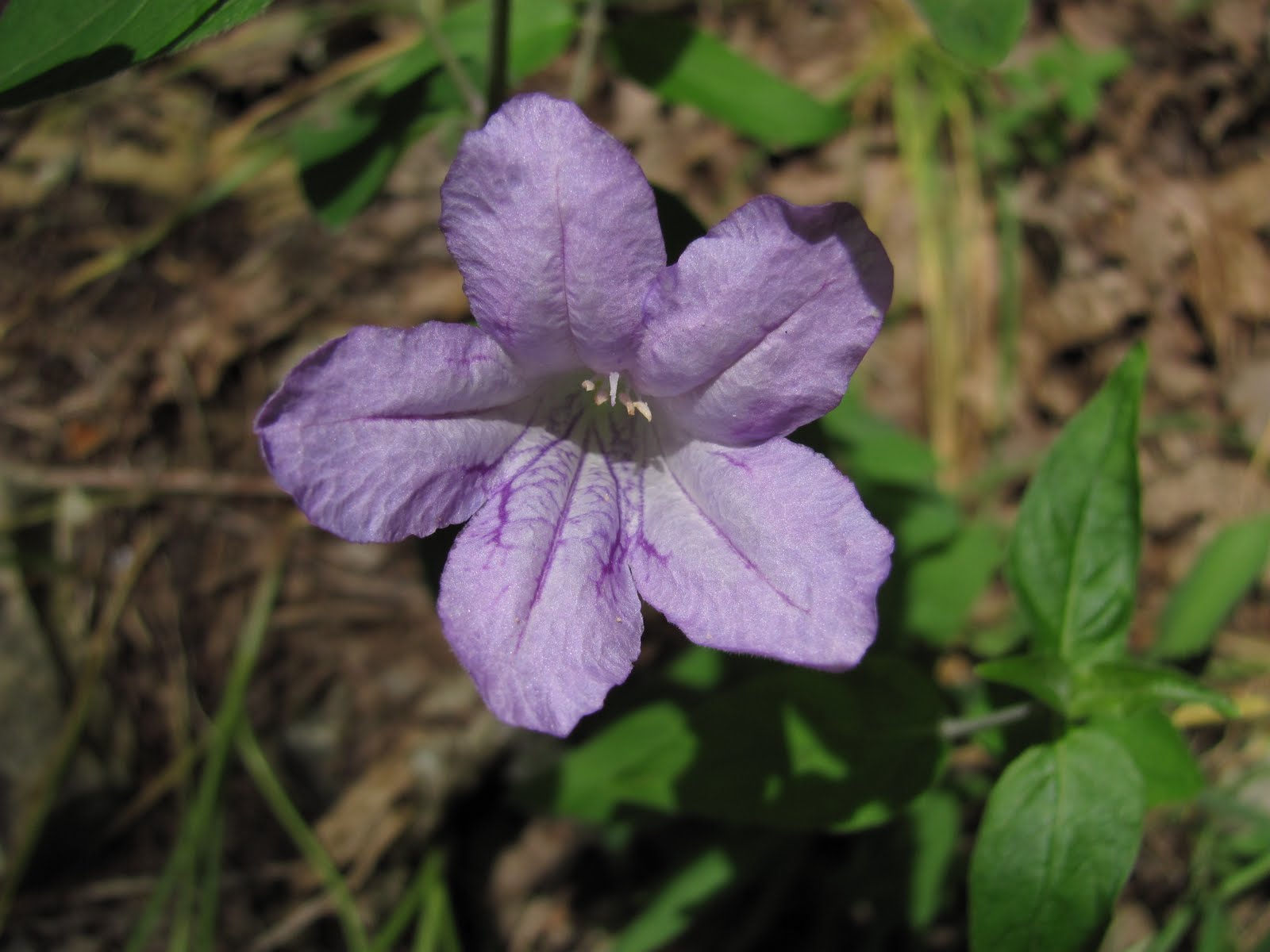
Ruellia

Yarrow

Prairie rose

Yellow clover

daisy fleabane

The wonderful golden seed puff of goatsbeard

Not your average garden! But this is where they all live, and do it so beautifully!

Many of these grow in my garden, and I find that they do very well. (Note: Most of them have come on their own, with no help from me, except to recognize them when I saw them.) Almost too well, in fact. With good soil and plentiful water, the majority of them tend to be a bit invasive, or at the least, extremely aggressive. They have to be tended to with a ruthless hand, pulling them out with no sentiment or there would be no paths or beds, just a sea of wildflowers to wade through! Which, come to think of it, might not be such a bad thing!

"A wildflower is just a weed with a pretty face. If ragweed was beautiful, we wouldn't care if it made us sneeze!"---Anon.
To learn more about the Roaring River Conservation Opportunity Area, please visit their website:
http://mdc4.mdc.mo.gov/Documents/17987.pdf And if you get an opportunity, visit in person!

Sunday, April 25, 2010

Walk at Wildcat

It was a cloudy day that looked like rain, but the thought of a little water never detered us! Off we went to Wildcat Park.  The site of The Wildcat Glades Conservation & Audubon Center, Joplin, Missouri, is adjacent to some of the last remaining chert glades, a globally unique habitat found only in this area and the biologically rich Shoal Creek; an important place for migratory birds and other wildlife. The park itself has been in existance for many years, with primitive hiking trails and fishing along Shoal Creek, but the chert glades were slowly being destroyed by human misuse. A few years ago, in partnership with Audubon Missouri, the City of Joplin and the Missouri Department of Conservation, spearheaded by a group of concerned citizens, the Center was established. Opened in 2007, the Center itself is, as their brochure states, "a celebration of nature. Innovative "green" technologies create a truly distinctive building in keeping with our mission of appreciating, conserving and understanding our natural world." The local Missouri Department of Conservation offices are also located on site. New trails were built and paved, a bluebird trail was set with bluebird houses, native trees and shrubs were planted and much clearing of trash and restoration of the natural woods was done, largely in part by a group of dedicated volunteers who work tirelessly and ceaselessly to make the center a viable, living thing for all to enjoy.

There is wonderful diversity of life here! From the rocky chert glades to the lush river growth and beautiful wildflowers, it is a wonderful place to spend a day. Trails wind through the park, along the river, across bridges to neighboring McIndoe Park and back, about a 3 mile walk, most of it easy, some of it a bit of a rough hike around and across cliffs and ridges. We only walked about a third of it today, taking our time, lots of photos and enjoying the park. It never did rain! Come walk along with us!

A glimpse of the glades

Just a tiny corner, rich with miniature plant life.


A fine pair of Canada geese


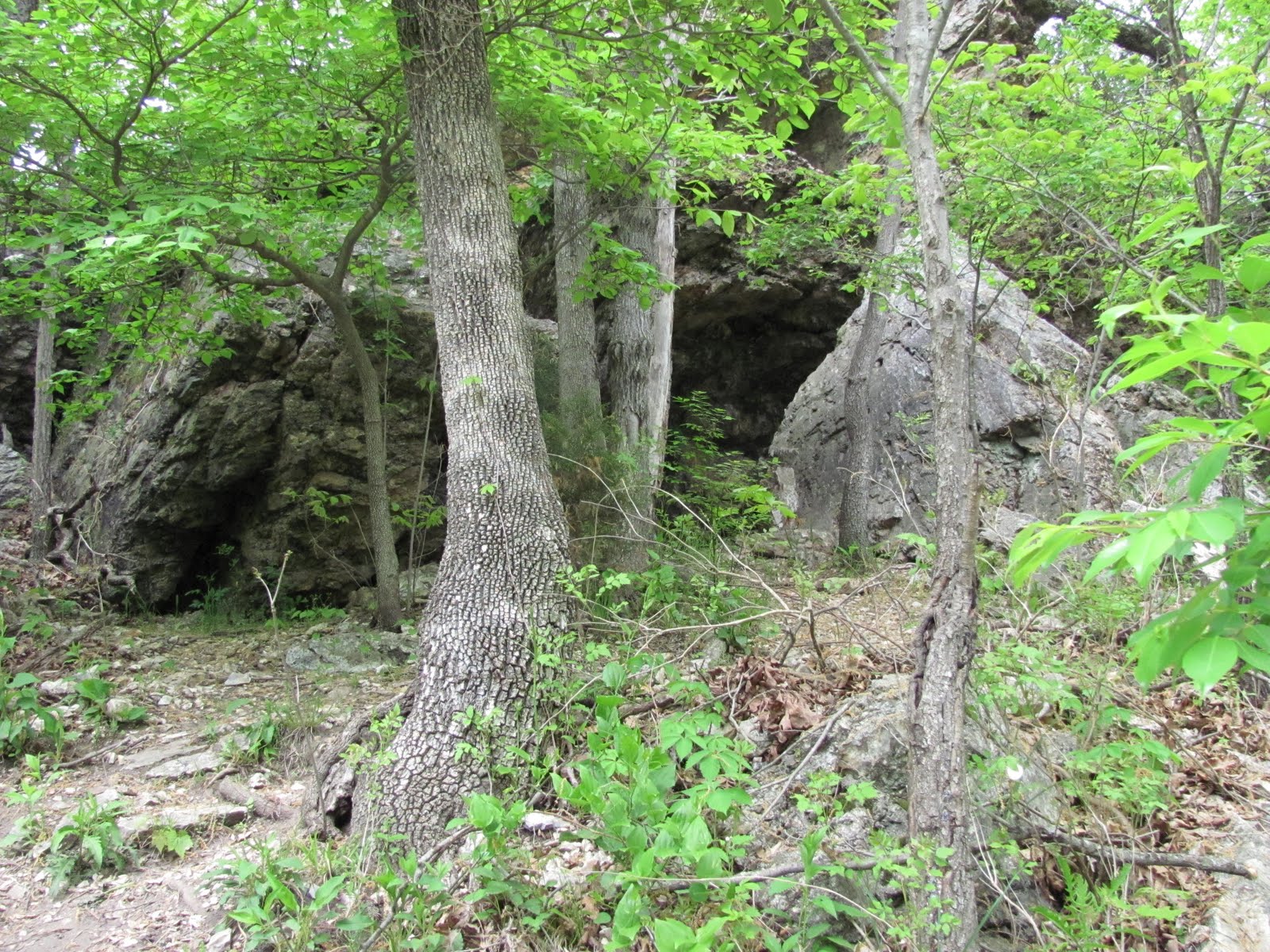
This is the entrance to a cave, one of many in the area. The actual entrance is gated to  keep it from being destroyed. Can't you just imagine early Native Americans using this? Perfect location on the river, plenty of chert and flint for arrowheads, game, shelter. Osage was a local tribe but there were others who traveled through here and also there were prehistoric tribes in the Ozarks. 


This Canada Goose had a quiet little cove all to itself.
This is wild impatiens, or jewelweed (Impatiens capensis) . You will often find it where you find this:
Poison ivy. Jewelweed is an antidote for the rash.

This is the old Reddings Mill bridge. It was taken out of service and a new one built; it is now part of the trail system.

Baptisia, and a fine fat bumblebee that wouldn't stop and pose for me nicely. He was much too busy.

Picnic tables and benches were donated to make the bridge a rest stop. Here we would cross the river and follow the trail on the other side. Today this is our point to turn back.

Looking downriver

Headed for home.

Blackberry blossoms

Lousewort (Pedicularis lanceolata)
Native viburnum


Camassia

The park will be closing soon so it's time to go home! Thanks for walking with us. We'll share with you another part of our park another day. If you'd like to read more about Wildcat Glades, here's the link:
http://www.audubonmagazine.org/features0905/auduboncenter.html