Showing posts with label lilacs. Show all posts

Saturday, April 17, 2010

My Haunted Garden


I used to see her wandering the south lawn, tall and grey headed with her hair pinned back, wearing an old grey pocketed sweater over a print house dress straight out of the 1950's. Although she wasn't young any more, her back was straight and her step firm. The first time I saw her, I thought one of my elderly neighbors had come to see what I was doing to the yard, and I stepped out the back door to say hello. But she wasn't there. I walked all the way around the house, and saw no one in the yard at all, so I just chalked it up to my over-active imagination, thought I was seeing things, shrugged and laughed a bit at myself, and went back inside.

She was back a day or two later. This time I just watched her for a few moments. She walked along the bed in front of the stone wall where I had planted a row of lilacs, stopping now and then as if peering at the ground at her feet. Then I turned my head away for a second; and when I looked back, she was gone.

She came quite frequently at first, every time I did something different to the growing flower beds; or when I cleaned out and weeded one of the old beds. I tried to follow the original rock borders, saving as many of the old perennials as I could find. It seemed as if she was inspecting my work, curious to see what I was doing, if it met with her approval.

She came less and less often as the garden progressed and began to thrive again under my hands. The renewal of her beloved plants must have satisfied her, for I haven't seen her for many years now.

I found out later that this lady who built our stone house, dug the basement single-handedly, and raised several children in the one-room cabin that was still standing when I moved here (later torn down) loved flowers and would spend all of her spare money (which wasn't much) on what new plants she could find for her garden. She raised a big vegetable garden and orchard where our woods now stands, clearing rock on the hill (no mean feat in the Ozarks!) so she could till the soil.  Piles of rocks still exist in the woods, as I often discover when trying to plant something; and the fencerow is (now) two feet high, three feet wide and running the length of the back of the property, along what was the garden (about 200') of rocks.

Euphorbia and wild geranium

Back in those days, I spent a lot of time at the library checking out garden books, and I must have been following in her footsteps as she set about to create an English garden. I could see some of the combinations she used, straight out of the pages of those books; a ferny green euphorbia with yellow flowers, planted with wild geraniums; mock orange with lily of the valley.

There is still a hundred feet of powder blue irises that smell of grape Nehi soda, interplanted with orange daylilies, that runs the full width of the front of the yard, a good 10' wide. It is a glorious sight in May! She planted naked ladies (lycoris): (the progeny of which are now in nearly every bed in the garden), probably every variety of iris she could get at the time, daffodils in abundance that bloom from the earliest yellow in February, to doubles, poeticus, and others that don't open until the first week in May. I have no idea of the names of most of them.

Old irises are starting to bloom on the north side of the house

Epimediums, still growing strong in their original spot!

Chrysanthemums, October 2009

There are still epimediums, grape hyacinths, (now in glorious abundance), phlox paniculata, star of Bethlehem and peonies; a chrysanthemum that opens creamy yellow and ages to pink--and spreads agressively! Perennial sweet peas are also part of her legacy. There is some variety of (maybe) Louisiana irises that have an open, flattish purple-blue flower, deep roots and colonize with abandon. A Seven Sisters rose, that has now gotten somewhat out of hand, used to adorn a rock cornerpost in the front yard. Now it clambers up a redbud that has sprung up nearby. Several smoke trees, including one very old and gnarly individual, seem to be original, as well as a hawthorn with some wicked nasty thorns. And not to be forgotten, the tulip magnolia that was so beautiful this spring, a deeply pink dogwood, and white lilacs.

Grandfather American smoke tree (cotinus) March 2010. I expect every year that it won't leaf out, but it always does.


Ancient white and purple lilacs

Blackeyed susans live here too, and coneflowers, columbines (Granny's bonnet doubles), giant toad trilliums, spiderwort, nandinas, scarlet honeysuckle, autumn clematis, forsythia, and crape myrtle "colonize freely" all over the place. I haven't forgiven her for the ground cover euonymous, but I live with some of it. So far. (One huge vine on the stone wall has a trunk the size of a man's leg, so you know how long that has been here!) My neighbor two houses down the street who has lived here since she was born, talks about the tall hollyhocks that used to bloom above the wall. Even though those are no longer there, I still have their descendants growing down along the herb garden fence.

"The panthers of the meadow,tiger-lilies". -Titus Munson Coan

And the tiger lilies! They stand a stately 5' tall when they bloom, hundreds of them! They reseed freely here and there and I never know where to expect another one among the garden beds!

 I mourn the loss of some plants that seem to be irreplaceable, expecially a yellow dwarf daylily (hemerocallis) that bloomed in April (it just disappeared one year), I have tried to find a replacement but it may be lost to the nursery trade. I still keep hoping it will show up somewhere in the garden  A lovely white Japanese viburnum simply declined and died one spring. There was another pink dogwood that graced the backyard but it succumbed when a black walnut grew into its space, and they disagreed with each other. Dogwoods and black walnuts just can't seem to get along; probably because of the alleopathic chemical juglone produced in the walnut roots.

I know that she traveled, and brought back seeds and plants wherever she went, as well as rocks and seashells that she embedded in the stone walls of her house. She made piles of interesting rocks under trees, perhaps leftovers from the house walls; and used them around her garden beds.

She didn't like dogs, and fenced the whole yard to keep them out, and to keep her cats safe from them. As far as I know, there was not a husband in her life, though there must have been at one time. I don't know what happened to him.


There was a concrete birdbath, embedded with shells, stones and bits of jewelry. I have found most of the broken pieces and used them as a surround for a tub of yellow water iris.

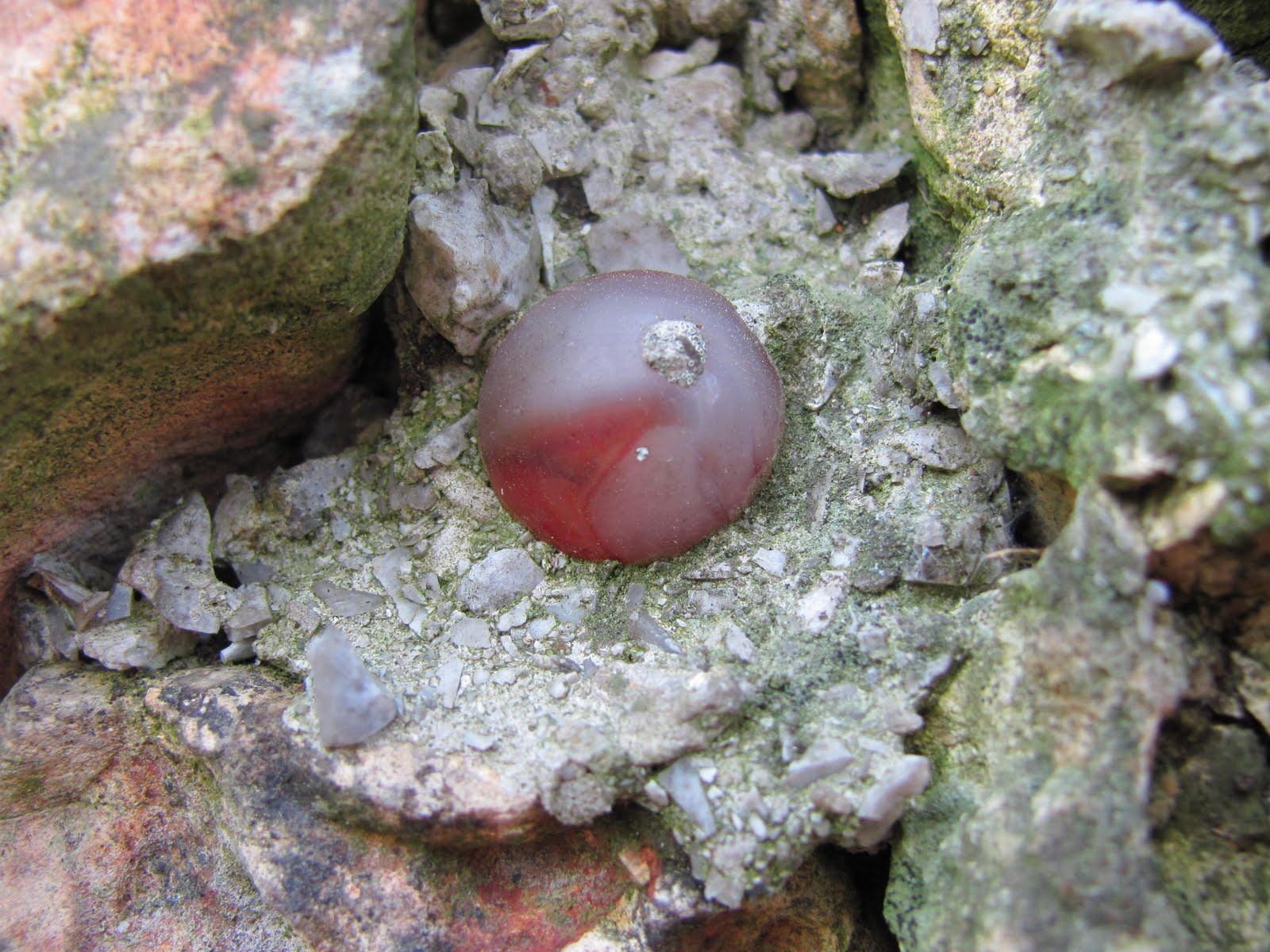
A stone wall runs a hundred and some feet on the south, and all sorts of things are embedded in it--pieces of dolls, more jewelry bits, marbles, pieces of glass and china, and shells.

The original wire arbors over the front and side gates are still here, and most of the fences around the house. There are only remnants of the fence around the woods, most of it having rusted away, though I still find buried pieces of barbed wire from time to time. I've found intact dishes and small perfume bottles in the soil, and once I found a set of wedding rings, deep beneath a tree that had to be cut down. (Now there might be a story!) Other finds include a pair of rusted cap pistols and just yesterday we discovered an old wrench that finally surfaced on a woods path. We usually hang the metal artifacts on the studio and toolshed walls.

The siding on the studio is cut from tongue and groove boards that clad the one-room cabin. Board and batten ceiling from the old structure was made into a cupboard I use on the back porch for garden sundries, boots and gloves.

Sometimes I wish she would come back again for another look. I would like to know what she thinks of her garden now. I miss her, this lady I never had the chance to meet but feel I know so well. I live with her in small ways, every day, for her personality is stamped upon this house and garden as surely as our own. She would have been a good friend.

"Where is heaven? Is it not
Just a friendly garden plot,
Walled with stone and roofed with sun? "
                                             --Bliss Cameron

Thursday, April 15, 2010

The Garden Club is Coming!

The garden club is coming!
Words that used to send me into a flurry of cleaning, weed pulling and trying to make everything picture perfect. Tomorrow, the garden club is coming to our garden. I finally realized after years of Martha Stewartism, that they are not coming to see my perfect garden. They are coming to see spring! And that, we have. Of course, last week was the peak of the redbuds, we still had lots of daffodils, and oh yes, last week was perfect! Next week, there will be thousands of irises, the hostas will all be up, and oh yes, next week, the garden will be perfect!  But let's take a stroll around the garden anyway and see what we have to share tomorrow!

The new Arkansas Black apple tree has blooms! Ok, there is only one cluster, but that means next year there should be many.

Lamiastrum "Yellow Archangel" is a spreading ground cover that is pretty invasive, but it is beautiful in bloom. Especially with lunaria (money plant) blooming in its midst. If you look closely, you can even see the yellow oak pollen covering its leaves!

Speaking of oak pollen, here is one of the culprits. This one is right next to the house and dusts us thoroughly with gold. The oaks are beautiful in bloom, especially in the morning with the highlighting its branches. We will have to rinse off all the garden furniture and deck before company comes or all of our guests will be wearing yellow! Next week we will be covered in falling oak flowers, so it wouldn't be a perfect garden then after all!

Tiarella is pretty in frothy pink, with white violets

Giant Solomon's seal  has hung out its pretty white bells

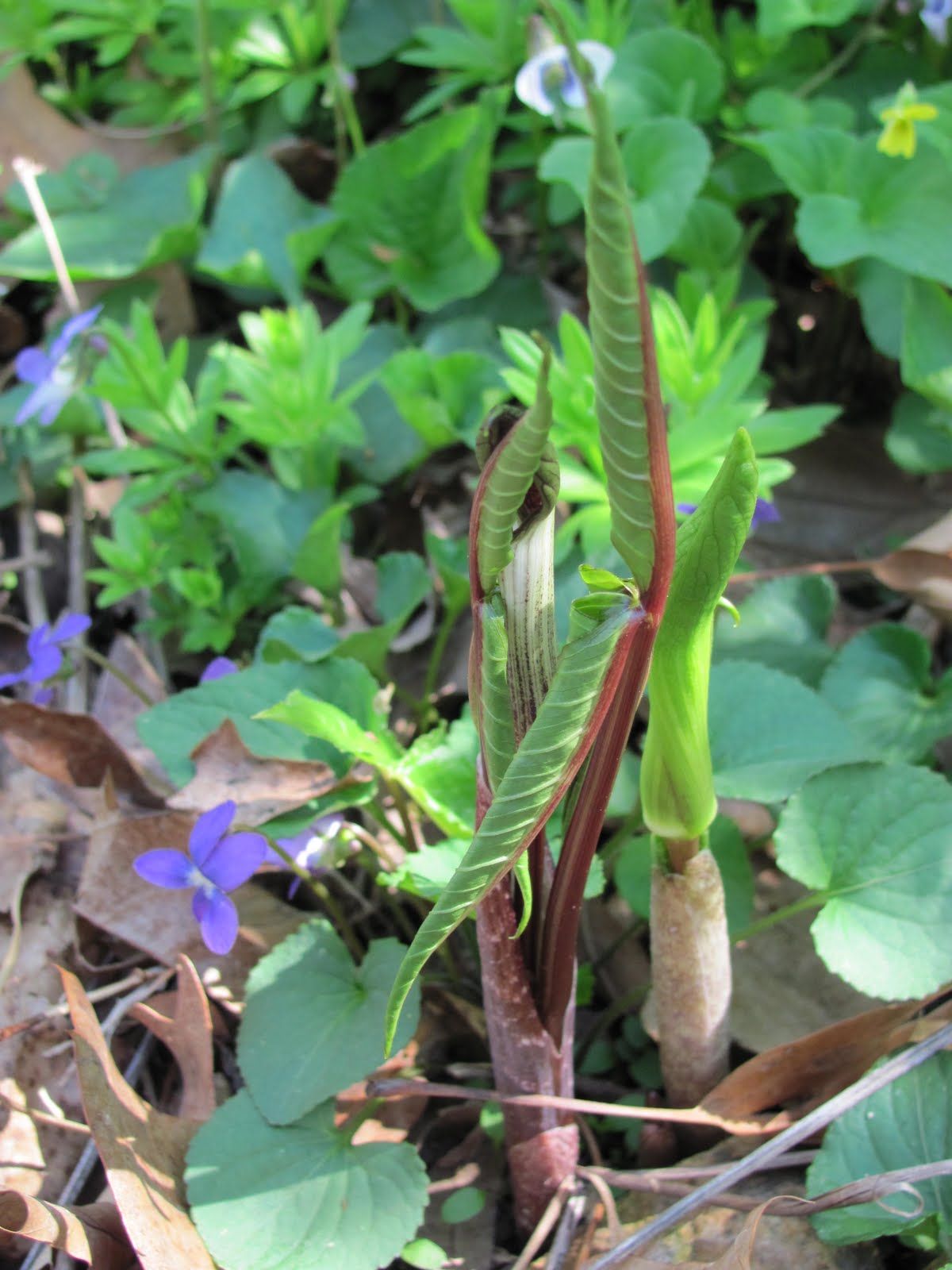
Jack in the pulpit has bloomed--and look at that, two flowers, and they are both different! What goes on here?

 
Sweet woodruff puts on a dainty show.

Camassia is beautiful in blue.

And the dogwoods are extra beautiful this year!

Of course there are still lilacs, and viburnums, sweetly scenting the air.

Still lots of Virginia bluebells and old-fashioned bleeding heart.

Geranium maculatum, wild geranium, will be showy in the woods along with plenty of wild phlox, which is just now at its most beautiful.


Merry bells are ringing still!

Ajuga is carpeting the ground in blues, whites, and pinks with green, bronze and black leaves.

One of my spring favorites, a shooting star! (Dodecatheon).

There are still penty of daffodils, though the early ones are gone and some of the others are fading a bit but still pretty, like this reverse-color cup.

Emergence! Blue irises are always the first to open, and there will be many of these tomorrow.


Even the dandelions are beautiful. Who says they are just a weed?

There are still lots of flowers going on, on the woods walk Mayapples are knee high with fat bloom buds, and trilliums abound, with the white ones shortly to be succeeded by the nodding red "Wake Robin".

And here are lilies of the valley! These are pink but most of them are white. Another lovely perfume on the spring air.

 
 Green and gold (chrysogonum) create a tapestry under azaleas that will be open tomorrow. 

Hostas are shoving fat stalks up as fast as they can, that rude Wirginia waterleaf is getting ready to redeem itself with puffy blue clusters, heuchera have tall flower stalks, there are violets everywhere in yellow, blues, pinks, reds, whites and purples, and late tulips blooming along with the early irises!

Come on in, Garden club members and friends! There's lots of spring to see, and grilled rainbow trout for dinner!

"Bright coral bells, upon a slender stalk,
Lilies of the valley edge my garden walk.
Oh how I wish
that I could hear them ring,
But that will happen only
when the fairies sing."
--old song

Monday, April 12, 2010

Fertility Rites, Going to Seed and What a Difference A Day Makes


Spring is a wanton, wild, virile, fertile time of the year. Sex is everywhere. Birds are mating, nesting in every available tree and shrub.  Butterflies are emerging from over-wintered chrysalises, bees and wasps are pollinating everything in sight, and squirrels are chasing each other in wild leaping abandon across treetops and over roofs. Frogs and toads are singing, full of it, until every square foot of water is full of gelatinous ropes of eggs, and black with tadpoles and polliwogs. And the flowers! They are ALL about sex, flaunting their spring wardrobes, their only be-all for existence to make seeds,to fling them to the winds and chance, spreading their kind far and wide. Many of the spring flowers haven't wasted any time, either! They have already bloomed and are ready to send out seeds to conquer the world, one at a time!

Bloodroot (sanguinaria canadensis) almost at bursting point, looking out for new territory

Celandine poppy, (Stylophorum diphyllum), getting ready to claim new real estate

Daffodil seed pod--planning for the future, 5-6 years from seed to bloom! They also increase by division of bulbs, but the seeds get scattered at quite a distance and start new clumps away from their parents.  Sometimes one old clump will have neary a hundred bulbs! (background leaves are false Solomon's seal, smilacina racemosa)

This is kinda fuzzy! There are hundreds of these, adder's tongue, (Erythronium Americanum) on the march to cover as much new ground as possible, both with seeds and division of bulbs. ! Here's another that will be several years from seed to bloom; making huge colonies of plants with single leaves, that only show themselves for about a month in spring until they disappear until next year.

Hellebores have their seed pods set already! This is Helleborus Niger, the so-called Christmas Rose.

Something seems to have changed in the woods this year. More exuberant, maybe, surely more fertile. I think the woods has undergone a change in dynamics.I'm not sure just what the cause is. Possibly climate change, perhaps it's the rooting out of all that honeysuckle that used to cover nearly every square foot of the ground except where the wildflowers grow so closely interplanted that not an inch of ground shows between them.
Yellow corydalis, ( Corydalis flavula) "colonizes nicely" as they say in the seed catalogs, but it is a dainty, ferny plant that is always welcome wherever it shows up.  An old name for it is "yellow fumitory".

Or perhaps it was the dry creek and re-routing of major paths. Whatever the cause, and maybe all of the above; as I work around pulling weeds, small trees and honeysuckle bits that I've missed, I'm finding all sorts of small wildflower seedlings where there were none before. Some are more than 50 ' away from the original
stands; bloodroot, trilliums, dutchman's breeches, ginger, virginia bluebells hundreds of feet from any other colony; even tiny woodsia ferns barely an inch tall.  One hellebore seedling somehow found its way down to the bottom of the woods. It seems with the honeysuckle gone, all these plants have the freedom to go exploring and stake out new territory! I must be careful where I step so I don't crush these baby colonies. I love to see them spread like that! In a few years, they will carpet the entire forest floor.

I have planted masses of lysmachias,(two kinds), Virginia waterleaf, common daylilies and a chrysanthemum that reseeds as well as spreads by stolons, in the bottom of the woods, all together. I'll let them fight it out for territory as they are all greedy and aggressive claimers of property. If they can live together it ought to be a colorful spot! There's nothing else down there for them to crowd out except a few irises, so we'll see.

What a difference a day makes!

There are surprises every day in a spring woodland garden! As I wander around down there peeking under leaves and and peering around trees, I find all kinds of things that weren't there yesterday.
White trillium (trillium grandiflorum) I always look anxiously for these as they come up later than the other trilliums, but they always come back, and sometimes there is a new one where there wasn't last year!

Yellow trillium (trillium luteum)

Here comes Jack in the pulpit (Arisaema triphyllum)!


One of my favorites, hardy orchid (bletilla striata) in bud. They will be blooming next week.

The deer ate the first flowers of pasque flower (anemone pulsatilla) but they put out some more! I covered them with an up-ended flower pot tonight as the deer were lurking in the meadow Out Beyond waiting for me to leave so they could have their way with my plants! I guess the clover and lespedeza that grow in the meadow aren't tasty enough for them.

Merry bells or bellwort (uvularia)

Bird's foot violets (viola pedata), one of my favorite violets. This violet is a prairie plant and loves full sun.

Jacob's ladder (Polemonium) I wouldn't be without this pretty, dainty blue.

Tritellia (lpheion uniflorum) This is a little bulb that will spread willingly and wantonly, and last for weeks in the spring garden, well into May. Its beautiful blue flowers seem to glow in the dusk.

Woodland phlox (Phlox divaricata) Can be any shade of blue, sometimes pinkish or white. Strongly perfumed and blooms for a long time. Lots of cultivars but they still mostly look just like this wild one!

Flowering almond (Prunus glandulosa) Wonderful flowering shrub! The one that grows here came with the garden and is probably 10' across.


Viburnum Carlessi Korean Spice. Can't you just smell this? Wonderful!

Combine this old-fashioned lilac with the above viburnum and it is fragrance heaven!

Praiie Fire crab (Malus "Prairie Fire") Today it's in bloom! 

What is tomorrow going to bring? I can't wait to get out in the garden!

"With fields full of clover and the apple trees,
The rosy richness of a springtime breeze,
I forgot all the work I'd planned to do
And just loafed in the meadow till
The day was through."
--Edna B. Hawkins