Showing posts with label sacred spaces. Show all posts

Monday, May 10, 2010

Ah, the darling buds of May!

Seems like summer has sprung, full blown, from the hopeful days of March and April. Spring has flown by on beautiful gossamer wings, flitting off in such haste that has left me shouting, "Wait! I'm not done with you yet, I didn't get to see.....where are you going so fast?" Already the roses are overnight bursting into full bloom, and the rhododendrons haven't even finished opening up.


Red Knockout Rose!

We have been gone for 4 days, at the Tri-State Gem and Mineral Show here. It was an outdoor show, and it alternately rained, hailed, and gusted windily (is that a word? ha!) except for the last day, and most of it it was absolutely miserable, wet and chilly. So coming back to the garden was truly a marvelous adventure. With the rain and a couple of days of sunshine, everything seems to be twice the size it was a week ago and dramatic changes are everywhere.

And what a year for the irises! I am in love with irises, this time of the year. (Of course I am in love with whatever's blooming, at any given moment!) The newer cultivars are absolutely gorgeous, but I think I love the old varieties best. Some of the new ones don't seem to have much fragrance, which to me is the soul of the flower. Like with roses, all that hybridizing seems to have removed the essence and just left the lovely faces.

One of my favorites, an antique that started blooming again after I divided it and gave it some sun.

A new combination has struck me like a revelation: I am going to save seeds of wild columbine and scatter them in the bed of yellow iris for next year.


Won't these be pretty together?

The wild roses are blooming in the woods, scenting the air for blocks around. Kind of makes up for the scentless Knock-outs, which I love for their beautiful, don't-need-any-coddling ways. Therese Bugnet has buds, but being somewhat shaded by lilacs that have grown to tower over her, is just going to be subtle these days. Plus, I found a caterpillar chomping merrily away at her the other day, and it had already stripped a couple of branches. I removed it to a wild rose where it can chomp to its heart's content and not do any appreciable damage.

Therese Bugnet

The wild roses are multiflora roses, a type of rambler introduced from Asia
 to the eastern United States in 1866 as rootstock for ornamental roses. Beginning in the 1930s, the U.S. Soil Conservation Service promoted it for use in erosion control and as "living fences" to confine livestock. State conservation departments recommended multiflora rose as cover for wildlife. More recently, multiflora rose has been planted in highway median strips to serve as crash barriers and to reduce automobile headlight glare. However, because if its tenacious growth and rapid spreading ways, both through seeds and its habit of tip layering its log canes, it has made its way to the noxious plant list and is a scourge of farmers everywhere. I don't think there is anywhere it won't grow; sun, shade, open fields, woods, gardens; and it is lethal to mess with, having prodigious thorns that catch everthing within reach and rip clothing and flesh alike to ribbons if it has a chance. Its saving grace are the wonderfully scented white flower clusters, and the only reason I keep it around. When it is done blooming, I will arm myself with leather rose gloves and a sharp pair of pruners, and reduce it to about a three-foot mound (currently, they are reaching 8 feet and still climbing!) and while I'm at it, I'll dig out its new tip-layered progeny. It will spend the rest of the summer regaining its size, and next spring again be covered with buds. (I'll have to look out for cardinal nests, they like it because it's safe from marauding cats in there!)

A wild pink dog rose grows by the edge of the wood and I've planted a beach rose that I got from a friend who summers in Maine. It too is a thorny, dangerous thing that spreads, but more of a ground cover type. I don't know its botanical name. It needs to be kept in check with a firm hand also but it's single deep pink flowers are wonderful.

 Speaking of cardinals, I don't know where they are nesting this year, but last year a silly pair built a nest in the magnolia tree right over the path off the deck, just overhead on a low branch. They spent the entire nesting season scolding and fending off anybody who walked under it, and frantically swooping at the cats everytime they came anywhere near the tree. They did successfully raise their family but are not back in the  same tree this year! I think they learned from experience and may be nesting in the euonymous that grows above the stone wall, away from any human and feline threat.

 I've added a few more plants to the woods this week. It took some hunting, but I finally found stoloniferous tiarella, hostas and toadlilies to add to the wildflowers. I have plenty of the clumping tiarella wherryi varieties in more disciplined parts of the garden, but in the woods I want them to spread and form colonies.

Tiarella cordifolia should colonize by the dry stream.
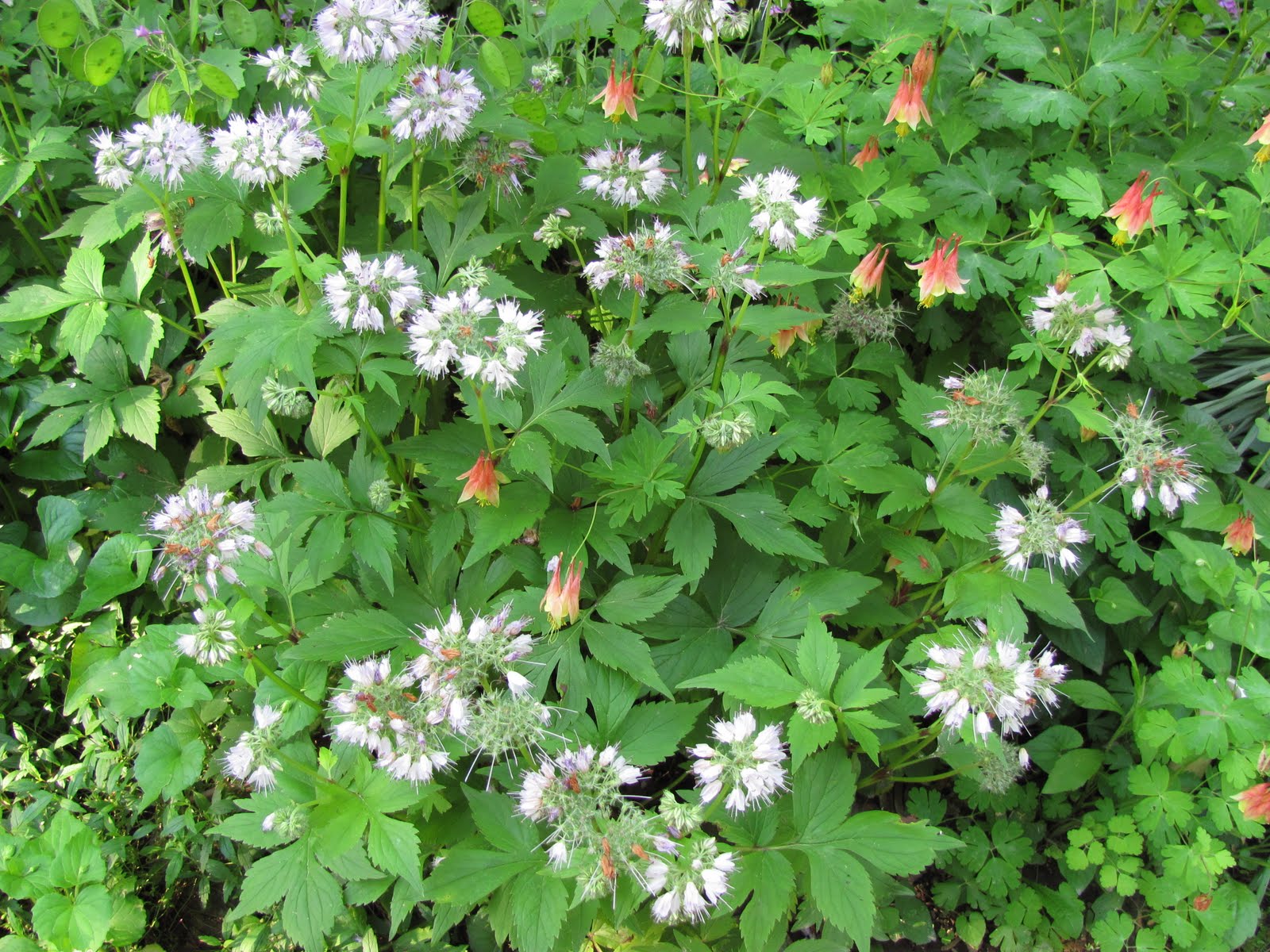
The last leaves of adder's tongue (erythronium) have disappeared for the year, and the path is open again. Part of today will be spent moving wild phlox out of it to a spot where it won't get stepped on. Wild ginger and ferns have almost completely covered another path and need to be relocated. It's still not too late in the season, and it's supposed to rain (again!) this weekend so that will be good for them. Butterbur (petastites) and giant solomon's seal that I moved last week are perky and happy already in their new homes with more wild phlox and ginger, surrounding a pussy willow and an old mock orange where only poison ivy and honeysuckle used to grow.

The cursed invasive Virginia waterleaf. Beautiful, isn't it?

Arum Italicum Pictum in bloom. You have to look under the leaves to find this huge flower!


I love the way this fern is opening up!


The woods has changed to summer dress. Some of this ginger has got to go! It will be transplanted to another area or donated to a friend's garden.

The moss along the dry creek is well established, in spite of the robins and brown thrashers. The woods is my favorite place to be. I often put aside my pruners and weeding tools and just sit on the old bench, listening to the birds and enjoying the serenity of this sacred space. It's the first place I go in the morning, savoring my coffee in the dappled sunlight, and the last place I visit at night when the air is cool and dim; listening to Nature speak to me in whispers of soft wind voices telling me deep secrets of the woods.

A visiting neighbor enjoys the garden too! Or maybe he just comes over for the petting.

A local resident out for a stroll among the violets.

Every day is an adventure in the Chaotic garden!

"Nature is a mutable cloud, which is always and never the same."
--Ralph Waldo Emerson


Saturday, October 24, 2009

Sacred spaces

October 24, 2009

I enjoy reading about gardens and gardening as much as I enjoy actual gardening . Well, almost as much. And I usually have a pile of 4 or 5 books that I bounce back and forth thru, as one will trigger something I read in another, and I have to look it up, and that one leads to....I was almost going to say down the garden path, but that might have been a bit kitschy. Right now I am reading "Why We Garden" by Jim Nolan, and "The World of Japanese Gardens" by Loraine Kuck; a vintage book I found in a flea market in New Mexico, one of the better Japanese garden books I have found. Nolan's book, about cultivating a sense of place, though wordy and esoteric sometimes, is profound, witty and informative, and it has made me look at my gardens with a different perspective. His chapter on sacred gardens is not so much about magic or myths, but how we connect to Nature and the world, the two being inseparable. Earth and her wonders are not put here for the convenience and comfort of humans; we are after all, simply just another part of Nature herself, just as the tiger, the elephant and the lowly snail. No matter what humans manage to do to the environment, Nature does go on at her own pace, with no regard to our comfort or safety.

Finding our sacred space is not so much creating or controlling somewhere in which to "meditate" as finding a balance between wilderness and the profaneness of everyday living. He says" The sacred garden is four-dimensional: not just a place but also a time....the sacred garden emerges when a sense of place is wed to a sense of the timeless." As all of Nature is sacred, a sacred garden can be anywhere; a single ancient tree in the middle of a forest, a peaceful riverbank, a human-designed labyrinth, a tree house, a sandy ocean beach, your own backyard full of plants you have lovingly cultivated. It is truly a sense and not a place.

Japanese gardens convey the sense of a sacred garden , a place to meditate, to wander and lose oneself in peaceful surroundings and connect with nature. They are works of art, and art itself is a sacred space. I find that I don't actually even have to be in a Japanese garden to feel that sense of place, timelessness and peace; just sitting down with the book and gazing at the pictures is all it takes. One totally forgets all the intense labor that has to happen to create that feeling, and wandering about my own garden carries with it that same feeling of forgetfulness. As I walk the mossy paths with my trowel in my hand and a bag of bulbs in the other, or just stroll with my coffee in the morning, I am in a sacred space. Watching a bumble bee with his head buried in a crocus bloom, rear end in the air and kicking as hard as he can to get deeper into the blossom; being momentarily startled by a female oriole as she lands briefly at my feet; watching a fat swallowtail caterpillar humping across the patio in search of a place to spend the winter; walking in the wet woods and being unexpectedly showered as a squirrel races through the soaking leaves above me, loosing a spatter of second-hand rain on my head---these are all manifestations of the sacred and even tho I might not stop to "meditate", the simple being out of doors and connecting with nature relaxes and refreshes my whole being. Problems and vexations vanish like dandelion fluff upon the breeze.

The Buddhists have a practice they call "walking meditation", which often involves working up a sweat, connecting with their sacred space through hard work, interacting with Nature, creating with her in their ongoing work of art. And that to me is the key to a sacred space--not trying to control Nature and Earth for our convenience, but working alongside and with her to create and protect our precious environment so that we may continue to have the sacred places that we need.

Sunday, October 18, 2009

Welcome to Chaos!

Complexity in Nature

“Thou blossom bright with morning dew
And covered with the heaven’s own blue
That openest, when the quiet light
Succeeds the keen and frosty night”
--William Cullen Bryant

Oct. 18. According to The Farmer’s Almanac, on this day in 1876 the US took formal possesion of Alaska (though what these history tidbits have to do with gardening I have always quite failed to understand). The sweet, sharp autumn air on this most glorious fall day would have made me a pagan if I wasn’t already one. As I breathed it in my whole being felt suffused with golden light. In the big driveway pots rosy pink chrysanthemums hung heavy, spilling over the pot rims in a drips of color, nearly touching the bright carpet of blood red dogwood, yellow hackberry and a veritable rainbow of oak leaves. My barely containable joy on this most magic of days burst wide with the discovery that the UPS man had left a package for me on the porch. My order of bulbs had come! I tore eagerly into the box, not even noticing that I was breaking fingernails in the process, and inhaled the fragrance the wafted from the bags inside—the earthy smell of crocus, tulips, daffodils, and the faintly , pleasantly skunky smell of crown imperial. Though the year was winding down, my gardening year was just beginning!

I have always loved the fall ritual of bulbs, hiding them in secret places among the grass and plants, between rocks and in flower beds, at the feet of trees and tucked beside the stepping stones where I would be sure to see them in the spring on my daily walks. Then in the spring, like the squirrels who have forgotten where they have hidden their acorns, I am delightedly surprised to find them in unexpected places.

My garden is not a new one; rather it is a collection of hopes, dreams and memories of many years. Definitely informal, wildflowers springing where they may, being allowed to reseed freely and only removed or thinned when they become so thick as to rudely crowd their neighbors out or get crushed underfoot. The “lawn”, or so we laughingly refer to it as, is a carpet of wildlings: spring beauties, wild phlox, dandelions, bluets, starry chickweed, oxalis, star of Bethlehem, buttercups in the spring, and only reverts to a mix of grasses and other green stuff in early summer, when it finally gets mowed, and then only in patches until the last of the wildflowers are done. I steadfastedly refuse to let anyone put any chemicals on it, only reseeding with bluegrass in the bare spots when I can’t stand to look at them any longer.

Shade moves across my almost-acre, leaving me with very few sunny spots and mostly dappled, shifting shade. Underneath my beloved wildflowers thrive and multiply in the beds that circle the stone cottage which shelters my husband and I, line the boundaries of our property and wander down into the woods. Some simply grow where they want to, and not always in the same places every year. It is always a surprise to have a whole group of black-eyed susans or Queen Anne’s lace suddenly decide to move 50 feet away to the other side of the house from one year to the next.

But it is a garden of constant change, both according to the whims of Nature, and of my nature. And today was for digging my trowel into the ground and planting, for new beginnings. As I dug into the earth I thanked the Mother for her blessed bounty, for the soft earth, the rain that would make my flowers grow, for the sunshine to give them warmth. A garden is not made by a gardener alone, nor in a day, nor in a generation even. It is a sort of hereditary thing that goes on and on, and needs cooperation between one and Nature; and Nature teaches the person and makes the gardener as well as the garden.Crocuses, daffodils, hyacinths and snowdrops go in the long, curving shady border at the edge of the lawn, in the transition zone between the house and the woods, among hostas, ferns, astilbes, coral bells, ajuga, columbine tricirtis, and under the two dogwoods, one pink and one white, that were planted this last spring and will eventually, in three or four years, grace this bed with their spring flowers. Gardening gives a person lots of time for thought, and as I dug in the warm moist soil I reflected that we plant, as we do things in all life, not for today but for the future, always looking forward to our vision of what we hope it will be like. It was 15 years ago that I began building upon this garden, in this place, and I am still looking forward to the next year of growth, in the garden as well as in myself.

It is time to take a break, and decide my next move. As usual, between ordering these bulbs in spring and the receiving of them in the fall I have forgotten where I intended to put them all. A garden diary, with copious notes, is a necessity in a garden as extended as this one. I really try to keep one each year, if only to write my notes on the calendar, but the proverbial best intentions….. As I sit on the picnic bench in the clearing, the October sun makes me shuck off my light jacket. Rustlings in the woods make me look: a pair of squirrels are playing chase in the dry leaves, tearing round and round in spirals up and down the trees and my Abyssinian cat, Tafari looks up from his perch on the retaining wall, ears perked and ready to join the game. A glimpse of blue through the trees catches my eye, and easily distracted that I am, I’m off down the trail that leads through the wood, my feet making crunchy noises in the leaves that are covering the mulched path. A patch of wild blue asters is blooming in the field beyond my woods and I pick a few for my kitchen window. My chair on the sunny deck beckons me and cup of mint tea in hand I sit and daydream over the garden, but not for long: soon I’m on my feet looking to see what’s going on down there. Weeds need pulled here and there, and before long my tea mug is put down somewhere and forgotten and I’m contentedly back planting bulbs.