Friday, January 10, 2014

What is a Garden Without a Cat?


 I miss my cat. If you have followed this journal, you may have met my Abyssinian garden friend, Ras TiFari. He was someone special, this companion of mine. Unfortunately, we lost him this year to intestinal lymphoma at only 6 and 1/2 years old. He was a great cat, one of the best, loving the outdoors. The garden was his playground, and he was an intrepid vole hunter, sometimes laying them at my feet, often just bringing them indoors to exchange for a treat, which he always got. He lavished love, head-butts and affection unconditionally to his beloved family, though strangers were a different story and he usually made himself scarce until they were gone.


RasTiFari came into this house on my birthday as an adorable, green eyed kitten whose ears were way to big for him; independent with a spirit of adventure that would not be denied. His main goal was to get out that door and see what it was all about out there,. It was all we could do to keep him inside until he got a little bigger and learned where he lived!

He charmed us all and soon wormed his way into the affections of Cutie, a 3-year old tortoise-shell that had belonged to my mom-in-law and was living with us temporarily. She adopted him as her own. Our Maine Coon, Grendel, affectionately known as Slasher (for good reason, but she came to us declawed and could do no real damage when she swiped at our ankles), not so much, due to her irritable and jealous nature. But she eventually came to accept him as her personal companion after he grew up, following him everywhere, albeit at a discrete distance, keeping an eye on him at all times as he loved to jump her from behind and roll her over--a game in which she participated with great glee whenever the tables could be reversed. She spent a lot of time trying to sneak up on him, and it wasn't easy! 

Ras TiFari--being an Abyssinian, he was named for Emperor Haile Selassie, of Ethiopia; formerly Abyssinia--was a intrepid explorer. He loved to ride in the car, as there was sure to be an adventure at the end of the ride, and went with us in our Airstream trailer on more than one occasion to the river campground where he got to go for swims. He was a real water cat. On his last day, before we took him to the vet for the last time, it was raining, and though he could barely walk, he insisted in going outdoors to make his rounds, to check on his beloved garden one last time. He went in the car wrapped in a towel, soaking wet but contented, I think.

Stupid cancer. It took him way too young, and we shall miss him always.


Cutie went back to live where she was born, and is loved and happy. She and Grendel the Slasher found they weren't compatible. A little too much jealousy there on both sides and both were unhappy.

We will always have a cat. This garden has seen a succession of them, and we have loved them all. The first to live here in this house was my younger daughter's black cat, Midnight, who came with me to live here 25 years ago. He was already aged, and has been long buried under a patch of Virginia bluebells in the woods. Midnight loved the garden too, and spent many happy hours hunting and taunting squirrels. He was another sweet, wonderful personality. Several years passed before another cat came into my life to stay, and that was in the form of a small grey tiger female we named Jasmine--Jazzy for short--who was very pregnant. We kept one of her kittens, a half-Maine Coon male whom we dearly loved. It was so much fun watching Jazzy teach him to climb a tree when he was just barely 12 weeks old. She would go up, and call, and he would follow, then she would back down and call, and he would do the same. It wasn't long until he was at the top of the tallest tree in the garden, and knew how to get down! His name was Sebastian. When I opened a bead/store studio here, he would meet the customers in the parking lot and bring them to the door of the studio. Jazzy disappeared one day, I think she just moved on, having accomplished her goal, raising her son and making sure he had a good home. Sebastian died on his tenth Halloween, for no apparent reason. Perhaps a heart attack, or other natural cause. He was a beautiful delight for every day of his life, and we miss him too.



Grendel came with my husband when we married in 2003. She was three years old, and already feisty and cranky. She looked so much like Sebastian that they could have come from the same litter, tho she was several years younger.


Potted Cat: Hey, Slasher, that's too small for you!


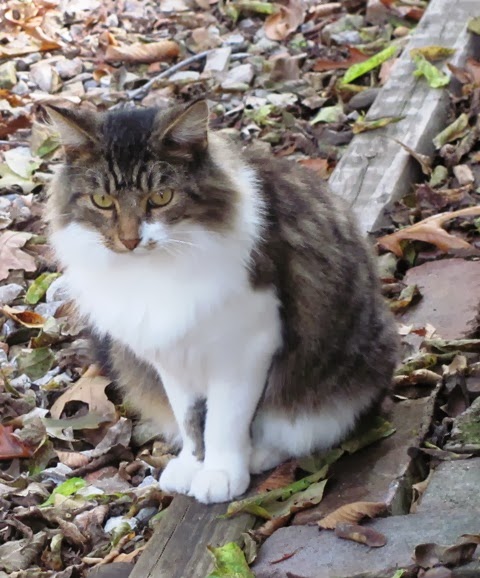
She has never met a box or basket or shoe she didn't like, and we still find her in all kinds of silly places. She is aging now, too, and seldom goes outside any more now that her companion Ras TiFari is gone. In her younger days she was an intrepid vole hunter also in spite of her lack of claws. She still has teeth, and she knows how to use them! Wary should be the mouse that dares to come into this house, as she is a good mouser too. She got sick right along with Ras TiFari and we thought we would lose her too, but I think she was so worried about him that she made herself ill. She lost weight from her 11 pound, chubby self and nearly stopped eating along with him; after he was gone, she gradually began to put on a pound or two, but she is still painfully thin. Cranky as ever, though missing her pal and nemesis. She is too old, irrascible and jealous to adapt to another kitten, we think, so there won't be one for the rest of her lifetime, even though the temptation is great.

There have been other cats who passed this way. A sweet, old, abandoned lynx point Siamese gentleman, who spent his last two years with us when his owners moved away and left him, ill and alone; he told us his name was Sukey. Another very old Siamese, Tia, who belonged to an elderly relative who had to move to a home where she couldn't have a pet; they were both great cats.


Sukey

 
 A pair of twin white kittens, who lived across the street were abandoned when their people moved away. They lived with us for a few months; very sweet, affectionate little boys. One had one blue and one green eye, and we think he is profoundly deaf. They were inseparable, and I think the hearing one took care of his handicapped brother. They went to live with three little girls who love them dearly.


 I think cats instinctively know where they can find help, and Ras RiFari brought a few home with him, including Sukey, knowing we would be kind to them. He had a lot of cat pals, one of whom is a friendly neighbor cat who has made our garden part of his territory, now, and visits me often for pets and ear rubs.  He hasn't told me his name, but he, too, has become one of a long line of garden buddies. He stood watch near the house all the time Ras TiFari was ill and stayed close by whenever Ras could be outside.


Goodbye, My beautiful sweet boy. Voles and kitty treats and wonderful adventures forever.


 Until one has loved an animal, a part of one’s soul remains unawakened. ” - Anatole France
 
What greater gift than the love of a cat.”
Charles Dickens


Time spent with a cat is never wasted.”
Colette

“I believe cats to be spirits come to earth. A cat, I am sure, could walk on a cloud without coming through.”
Jules Verne

There is, incidentally, no way of talking about cats that enables one to come off as a sane person.”
Dan Greenberg

"A cat improves the garden wall in sunshine, and the hearth in foul weather." - Judith Merkle Riley

"No amount of time can erase the memory of a good cat." --Leo Dworkin

"A true cat lover cradles a newborn kitten and knows that 9 lives will never be nearly enough." --Author Unknown


Tuesday, January 7, 2014

What a mess!


Mother Nature did some heavy pruning here in the Ozarks last week with the ice storm, and left a huge mess. In all fairness, she will eventually clean up after herself, but most of her human children don’t have the patience to wait while she takes her own slow time about it. Some residents began the cleanup immediately, but we didn’t have any inclination to get out there in all that ice, and besides I hate the cold. It freezes my toes and fingers, and makes my joints ache. We were lucky this time, no big limbs or trees fell on the house, power lines or cars that needed immediate removal, though I know many people were not as fortunate.

It seemed better for us to wait until the ice was gone, when we could tell what was actually damaged. Trees that were bent over double and appeared to be done for popped right back up once the weight of the ice was off. We spent one afternoon picking up fallen branches and litter so we could walk in the area safely to see what had to be done. Chaos is a designated National Wildlife Federation habitat garden, and we keep a brush pile at the end of the woods as shelter for small wild critters so we have a convenient repository for storm debris.


Nandinas down, but fully recovered.


Cypress x Nanjing Beauty, heart-stoppingly bent double but standing straight now.

 A couple of trees have to come out; an old Washington hawthorn cracked at the base and toppled, and a young wild redbud fell over in the woods. The hawthorn had fire blight every year, so it won’t be much of a loss. The redbud won’t be missed either as its location was too shady for it to bloom well. A Japanese maple might replace it.


Hawthorn has to go!

 A huge branch is partly broken off a hackberry, touching the ground over a hosta bed; it’s going to take some finesse to tackle it. I’ll have to cover each hosta and perennial to keep us from treading on them and crushing the crowns. Daffodils are already coming up everywhere, but being stepped on will only bend the tips of the leaves. The flower buds are at least a month away from showing.

Where branches broke off the trees, the stubs should be pruned back to the branch collars at the trunks to keep out rot and disease and enable them to heal over, at least as many as we can reach.  A big lilac trunk that broke will have to be removed at the base as it would likely die back anyway. “Widow makers”, as large, broken. hanging branches caught high in trees are called, have to be removed; it is dangerous to work or walk under them.  Where they are too high for us to reach, we will hire a professional tree service to do it. 

Much of the work can be done easily with pruning saws, loppers and a chainsaw. Jim’s experience as a nurseryman and landscaper gives him the know-how to do it though he isn’t eager to tackle the high stuff anymore.

But before you dash out to your nearest Husqvarna dealer and slap down your credit card to buy a chainsaw, safety first! Never let amateur enthusiasm rush you into taking a chance with something that could hurt you; if you don’t know how to handle it, hire someone with experience instead. If you must tackle the job yourself, don’t even think about going out there without gloves, safety glasses and a hard hat. Make sure the assistant that is hauling off branches is watching what you are doing and you also know where they are so they don’t get in the way of any random branch-tossing; or there may be bad words spoken and angry stomping off causing you to have to finish the job on your own. Keep your kids safely away while you are working on big stuff. They can be pressed into slave labor later to pick up small branches and twigs, or if they revolt, be paid for it.  

Valuable post-storm clean-up information can be found on the University of Missouri Extension website: http://extension.missouri.edu/p/g6867.  

While we are at it, the rest of the plants that were left for “winter interest” might as well be cut back as the ice laid most of them flat anyway. I’ll bundle Echinacea stems and others that still have full seed heads and hang them on the fence for the birds to finish cleaning out. Ornamental grasses can be cut back to about 10 inches tall, and perennials to about 6 inches, leaving just enough to hold the fallen leaves that mulch them through the winter.

When the cleanup is all done, I can sit back and dream over the garden catalogs that have started coming in the mail, at least until Mother Nature has another snit that has to be tidied up. But Mom, no more ice storms this winter, please!


 Winter is nature's way of saying, "Up yours." ~Robert Byrne


"How can those who do not garden, who have no lot in the great fraternity of those who watch the changing year as it affects the earth and its growth, how can they keep warm their hearts in winter?"
- Francis King 
 

Thursday, January 2, 2014

Garden of My Dreams


Frances Hodgson Burnet's "The Secret Garden" was one of my first fantasy gardens, and I still go there on winter days like these when snow has covered the garden with a protective blanket of white and the wind chill is below zero; curled up with a hot drink, a warm quilt and a pile of my favorite garden books.

My dreaming mind strolls down winding paths in a woods that is carpeted with ferns and
wildflowers. Violets edge the paths, and there are trilliums, bloodroot and bleeding hearts on mossy banks along a rippling stream, with robins playing in the shallow water  and the gentle buzz of honeybees flitting in the blossoms. It only rains at night or very lightly in the day, creating raindrop diamonds on the leaves; a softly glowing sun filtering through the trees creating shadowy, secret places where fairies might be watching. Toads wait under mushrooms and box turtles lumber along, seeking ripe strawberries in sunny clearings. There are no mosquitos, and goldfish flash their brilliant colors in a small, quiet pool that reflects the azure of the sky. Sometimes there is wispy fog in the morning, and it is hushed and quiet as I walk the paths with my morning tea, watching the squirrels play. I wear a long, flowing skirt with my hair floating over my shoulders, bare feet with rings on my toes. Does this sound like the beginning of a Disney movie?


Some days, I walk through a moon gate into the complete serenity of a Japanese garden, where every stone and perfectly pruned shrub is placed with careful contemplation, delicate and yet striking in simplicity. It is a cool place, shaded with Japanese maples and  cherry trees, a waterfall gently tinkling into a serene pond where bright koi flash in the ripples. My meditative mind spends a lot of time here.

Lush hosta gardens are on my dreaming list, and I am green with envy as I stroll down paths under towering trees with huge spreading hostas, ferns and beautiful dwarf conifers. There are no slugs, hosta-munching deer, or greedy rabbits in them to disrupt the peace and beauty of these gardens .


None of my fantasy gardens are the least practical, no perfectly ordered rows of vegetables and espaliered apple trees, with straight rows of tulips in the spring. My gardens aren't populated with fancy chickens, ducks and other fowls, in quaint coops. I can't see myself gathering eggs in an apron or spending my days hoeing weeds, gathering cabbages, picking peas and wasting perfectly good summer days canning in a hot kitchen. I did all that on the farm when I was a child, and my fantasy mind has shut the door firmly on that vision.

Nor do blowsy, intense English flower borders figure in my dream life. Perfectly manicured lawns and clipped boxwood will never be a place where I want to live either, although I enjoy looking at them from time to time, as long as somebody else does the work.
 
But the garden of my dreams, in my real imperfect world, will probably never be finished, for my real
dream garden is a project with no end, ever changing, always evolving, ever challenging. And that is the way I want it.
 
Because my favorite fantasy gardens seem to be all different (what does that say about my personality?) in the real world I've created something of each. I have my woodland, and wildflowers, although not as mystical as my dream world; there are really carpets of trilliums and gingers, mossy paths and wonderful stones. There is a small mossy lawn with boxwood, azaleas, Japanese maples, dogwoods and Japanese lanterns; there are wonderful benches and roses tumbling over stone walls and fences. There is also an herb garden, and blowsy flower borders that are not even in my dream world, but they have managed to insinuate their way into my garden, after all.


My real gardens are not like my dream world. They are alive, with beetles and butterflies, spiders, snakes, and toads. They are noisy. Birds singing, squirrels chattering away as they dig up my bulbs and make holes in the moss lawn, crows arguing with jays over a crust of bread. There are holes in leaves, and rabbits munch my pansies. Deer step delicately over a $5 hosta to lunch on a $50 one (how do they know?). Groundhogs leave nothing but the stems of the voilets, and eat the chicory to the ground. Cicadas and crickets buzz and frogs and toads croak and sing. Weeds grow at a dizzying rate and my cherished plants grow ever so slowly.


And they smell. They smell heavenly of lilacs, and roses, and hyacinths, and lilies and viburnums. They are pungent with rosemary, sage, thyme and refreshing of mint. They are fragrant with earth-scent, freshly mown lawns, spring rain-washed air and the spice of autumn leaves. Sometimes they reek, of garlic and wild onions, of compost and manure.


My real garden gets wet with rain, cold with ice and snow, and sweating hot with August. There are life and death, predators and prey, carnage among the flowers. There is sex, and procreation. Life.


I love my dream gardens, with their lovely, static perfection, where flowers never wilt, it rains only at night, and the sun is always just right. They are wonderful to visit in the midst of winter when my soul needs green days and warm nights, but I wouldn't really want to live there. Reality is so much better.


"From December to March, there are for many of us three gardens - the garden outdoors, the garden of pots and bowls in the house, and the garden of the mind's eye."
- Katherine S. White


Monday, December 23, 2013

Rocks in My Head!


 “You’ve got rocks in your head.” So said my family and friends when they found out the top thing on my Christmas list is a pallet of Arkansas stone. Again. It was the top item on my list a couple of years ago, also. I built terraces and laid paths in the woods garden with it, but one can never have quite enough rock. There are still places in the paths that wash out in heavy rain, and a few well-placed flat stones will cure that.

Of course, if I hadn’t been messing around building raised beds and paths, I would not have changed the drainage dynamic on the hill, and there would not be an issue, but there it is and now I need to fix it. Besides, it’s an excuse to get more rock.

But for once the snarky remarks are true; I do have a head full of rocks. From the time I was a little girl sitting in the driveway of the Michigan house where I grew up, sorting out colorful agates from the quarry gravel, and plunking them into a Mason jar full of water so I could see the pretty colors, I have been obsessed with rocks and stones. As an adult, I dragged my children down New Mexico’s gullies and arroyos, hunting Apache tears, petrified wood, opals and agates, in the process creating a rock hound of my older daughter. We decorated gardens, made collections, and every time we moved I picked them all up again and we hauled boxes of rock across the country until they finally found a home around our fish pond.

But the obsession doesn’t stop. Jim and I have rock hounded all over the US; in North Carolina, Arkansas, Oklahoma, New Mexico, Arizona, Nevada, filling our Airstream trailer and pickup with hundreds of pounds of stones—many of which have gone into our collections or were cut and polished to use in the wire wrapped jewelry I create—but most of them have gone into a small dry creek which bisects the woods garden, where they form a background for the wildflowers and mosses that grow there.

 Our own Ozarks are full of rocks, as anybody who has ever tried to sink a shovel into the soil here will testify. Besides all the interesting minerals that came out of the lead mines (you can see examples at the Mineral Museum in Shifferdecker Park in Joplin); sphalerite, lead, calcite, dolomite, pyrite et al, there is an amazing variety of fossils, Mozarkite, (a pink stone that polishes beautifully and makes wonderful jewelry), lots of mineral eggs of various sizes, and tons of just plain rocks. But even the plain rocks can be interesting. Some of them are real characters, with their lines and folds creating faces that make you think you are being watched by the spirits of the woods! Then there are the “holey” stones, with holes going all the way through, which, if you look through the hole and squint just right, you are supposed to be able to see into another dimension.

Who is this grumpy garden character? Look like anybody you know?


Or this guy? Boo!
A rock party!


Local calcite crystal

Fossil sea animal

Rocks are wonderful in any garden. Not only are they useful for houses, patios, walls, walks, benches and steps, there is a beautiful contrast in the solidity of stone and the softness of plants that lends serenity to a landscape; a fact that Oriental gardeners discovered thousands of years ago. In the Japanese garden, an entire culture is built around their careful placement.

We use them in the natural garden, the biggest ones we can find and haul home. Quite often good sized stones can be found at construction sites, they might be free for the hauling if asked for nicely. There are a couple of stone yards in the area also, where you can buy almost any kind or size of rock you want-which is where the afore-mentioned pallet of stone on my Christmas list will come from. We can’t, unfortunately, handle huge boulders here and I confess to severe rock envy when we see them used to effect in other gardens. Those big ones will just have to live only inside my head for now!


"You will find something more in woods than in books.
 Trees and stones will teach you that which
you can never learn from masters."
 ---Saint Bernard


"I love to walk the limestone cliffs
 in search of fossil stones.
 To read the story of time long past
Writ in dusty bones.                      
----S. Parrill


Saturday, December 21, 2013

Ice Storm!

 The only ice I care to see is in my tea in high summer. I hate ice storms. I'm ok with snow, rain, hail, whatever Nature throws at us (well, with the exceptions of tornadoes and drought) but ice storms are so relentlessly destructive, I dread them most of all.

This one started out innocently enough, a light rain mixed with a little sleet, but then the temperatures dropped just to the freezing mark and the rain turned to ice that started building up on the trees. It rained all day, and it just kept building up, and up, and soon trees and shrubs started bending double, their topmost branches touching the ground. It isn't cold enough for the streets to freeze with traffic-stopping ice but with nearly a half-inch of ice coating, power lines are sagging and snapping, causing power outages everywhere and police and utility companies to urge everyone to stay at home and not be out roaming the streets, gawking and getting in the way.


                          Shrub honeysuckle, nearly touching the ground. This is an upright bush.
 
The crashing sounds coming from all around are the most disheartening. We looked out to see our old Washington hawthorn toppled over, its root system heaving the ground, and big branches snapped off an old redbud in the front yard. I'm holding my breath over the dogwoods. One fairly young white one didn't lose its leaves this fall and it is bent double with an ice load on its leaves; but this is not the first time for it, and it recovered before, so we're hoping for the best this time too. A huge hackberry has lost at least one limb, and our bald cypress cross Nanjing Beauty is kissing the ground with it's top branches. We're hoping it and the white pines are flexible enough that once the ice is gone they will snap back upright.

 
Nanjing Beauty cypress cross. Does this not make your heart stop to look at it?


Hackberry branch is broken and down, as are many other big branches in the woods garden. Lots of cleanup looming in January.
 
There are quite a few old oaks and other trees in the surrounding woods that have been damaged by the droughts of 2011 and 2012, and Mother Nature is doing a pretty severe pruning job on them, taking out deadwood and causing many of the scary crashing noises.

The ice has turned our chaotic garden into a glassy crystal fairyland, though, in spite of the damage it is causing, lending an uncommon beauty to dead seed heads, grasses and tree branches.


Sedum Autumn Joy, encased in ice, looking like exquisite art glass


seedpods of Rose of Sharon


Euonymous alatus Compacta ( Burning bush) fruit
 
But the flock of flamingos that hang out by our vintage Airstream trailer appear to have their own opinion of this weather: "When's the next bus to Florida?"


Mahonia (Oregon Grape Holly) doesn't appear to be fazed at all by its icy frosting
 
 
"Winter crowns the earth with crystals rare
And places diamonds in her hair."
 
--unknown


Sunday, December 15, 2013

A Little Something Green


 A Little Something Green

Snow. Well, it is December, after all, and I suppose to be expected. Seems a little early this year, but every bit of winter moisture is most welcome, even though we’re all going to grouse and complain bitterly about it. (Whatever happened to zone 7?).  With temperatures dipping into the single digits a blanket of the white stuff will protect plants and keep the cold from freeze-drying them, as it could with bare ground.

It’s amazing the amount of plants that stay green in the garden all winter here. Years ago a gardening friend harped on me constantly about planting more for winter interest, and I guess all that nagging must have sunk in because on a walk around the garden yesterday I noticed that there was green everywhere, besides the junipers, nandinas, hollies and other evergreen shrubs and trees. There were holly and Christmas ferns, St John’s wort,  plenty of spring bulb foliage—scillas, grape hyacinths—as well as naked lady and saffron leaves; dianthus, spiderwort, arum italicum, heucheras, lamb’s ear, perennial geraniums, and basal leaves of most of the composite (daisy) family including coneflowers, rudbeckias, and daisies. I found liriope, honeysuckle, ajuga, euonymous, vinca minor, strawberry begonas (saxifraga sarmentosa), enkianthus, pachysandra, wintergreen and lamium. Plenty of spring blooming wildflowers get their start in late autumn, and there were tiny delicate wild ferns just coming up, corydalis, violets galore, lunaria, Virginia waterleaf, and my latest experiment, a loved plant from my childhood, trailing arbutus. There’s even a dandelion or two, butter yellow against the still-green grass!
Saxifrage (strawberry begonia)


Hellebore with Arum Italicum

But the hellebores steal the winter show, big, lusty dark green leaves; old plants are nearly big enough to be shrubs themselves. The so-called Christmas rose, H. niger, supposedly can start blooming in late December with pure white, single five-petaled flowers. I don’t know where they take those catalog pictures of them blooming in the snow; mine don’t usually bloom until early March. There are so many colors and forms of hellebores, from the dusty pink flowers of H.orientalis, the Lenten rose, to the newer cultivars of peaches, reds, creams, spotted and splashed flowers and doubles with delicate gold edges on the petals that it is hard to make a selection. I want them all! There are also H. foetidis with green flowers and foliage that smells bad when bruised, and H. argutifolius with beautiful silver streaked leaves and chartreuse flowers.


H. Orientalis in spring bloom

Most hellebores prefer light shade, are tolerant of even our rocky soil, and fairly drought tolerant too though they will wilt alarmingly during our usual August droughts and scare you into soaking them well. The old leaves can be cut back in February so the flowers show better but I prefer to wait until they finish blooming as I like to see the blooms against the leafy background.  New leaves will come up in spring and I cut off the old, ratty leaves then. My big 20 year old h. orientalis usually has close to a hundred flowers and is about 5’ wide, rivaling big hostas for size. Even the flowers are attractive when they go to seed, with their big green pods swelling in the centers of the petals.

 They are very prolific, too, casting their hundreds of babies close to their feet where they can be easily dug and transplanted in the spring and shared with friends. Varieties that bloom at the same time can easily cross, and you might find shades from pale cream, lavender, and pink, to dark wine red with spots and splashes of color through the petals, or not. If you don’t want them to reseed, just cut off the flowers as you notice the seed pods begin to swell.  It may take the babies three or four years to get big enough to bloom, but they won’t disappoint you. They are pretty low maintenance, and a bonus is that deer and other critters won’t eat them.

 I have them scattered all through the woods now, taking care to look down the road to their future size as I don’t want to crowd other plants too much. They are beautiful with daffodils, hostas, ferns and other shade plants, under oak leaf hydrangeas, and glorious in the winter when we crave the sight of something green!


Tuesday, October 29, 2013

Out of Chaos comes Change

It's been two and a half years since I have been here, and it just seems like barely a moment
in time. A lot has happened to change my world since then, truly chaos in action. A beautiful light went out in May of 2011 when my cherished younger daughter passed away, and we were still reeling from that when our city was struck by the most devastating tornado in history at the end of that same May. It was a sad and heartbreaking year already when we suffered a drought that summer, and the gardens weakened, no matter how much water we poured on them. Winter didn't help, there was little moisture even then, and what we got in the spring wasn't enough. Then another blow; record heat and more drought in the summer of 2012, months went by with plus 100 degree days and not a drop of rain as El Nino held us in a tight grip. Venerable old oaks and pines died, our gardens languished and fell back. We watered, but it was so hot that plants literally cooked in the heat. My beloved hostas got smaller, and some died, other perennials too, trying to survive by cutting back. We watered to keep the trees alive. Water bills soared but it was less expensive to water the trees than it would have been to cut them down if we let them die.

We went into the winter of 2012 with trepidation. It was clear that the changing climate might mean a new way of gardening for all of us, and we weren't ready for that change. Spring of 2013 brought a shift to La Nina, however, and we had a wet, rainy spring and rainy summer with mild temperatures, things grew lush and quickly as if making up for lost time. We learned the value of native plants--there are good reasons they have survived for centuries in the wild. August was dry, but it usually is, anyway, and life seems to be returning to normal, whatever that is now.

Our city is recovering from the tornado, there continues to be a rebuilding frenzy that promises to make it bigger and better than it was. Though there is an empty space in our hearts where our daughter used to be, we can remember her with love, and move on. A grandson has come to live with us; at the age of 6 he is a trial and a patience, and we are not sure that we are young enough to survive the experience! But we love him, and he is an altogether delightful and bright child. Even if he is a noise with dirt on it.

Chaos has indeed wrought a lot of changes in our lives, and we have learned a lot from the experience. Sometimes it's difficult to not regret what we've lost. It's hard for the human heart to let go of what we loved deeply and consign those things to loving memory; to accept a new way and go easily down a new and unknown path. But we are doing it!

Our city and many volunteers are planting new trees to replace those that were destroyed by the tornado, creating inner city forests and habitat; and that alone lifts spirits and gives hope. We have learned that out of devastation comes new life, and though the process was painful, we are better and stronger coming out of the ashes.Mother Nature will adapt, we will learn her new ways and because the human race is and has always been adaptable too, we will survive and perhaps become something new. In the process we must not forget to protect and care for our planet, it's the only place we have to live!

Wednesday, March 30, 2011

Balmy Breezes, Shivery Freezes and Rainy Days


The magnificent flowers of Tulip Magnolia (magnolia soulangeana) are sometimes lost to a late frost--but not this year!
                                                  
March never can seem to make up it's mind. It starts out in the morning shivering in a winter coat, and by noon it's shorts and a tee shirt. Two hours later and you're drenched in a sudden downpour, mixed with 3 inches of pea-sized hail and wind that litters the ground with thousands of tiny twigs and branches, usually just after you've just picked  up all of the debris from the last weather snit.Then the sun peeks out; Mother Nature laughing at her own perverse sense of humor (Not Funny, Mom!) and warms your body and soul , kissing you with fresh breezes and hugging you with the delicious scents of fresh flowers and moist earth.

Miniature daffodils
                                                                    
Tritellia, one of my favorite small spring bulbs
                                              
Peppermint stick (clusiana) tulips
                                                                 
The next day, you wake up to a skin of frost all over everything, the daffodils are shivering and the rhododendron leaves are curled up into slim fingers that makes you want to fit them out with mittens!  There's a promise of 70 degrees by Sunday, but.....are the promises going to be kept?

Butterbur (petasites) flowers come up before the leaves
                                    
Vinca minor atropurpurea with white grape hyacinth

Spores on moss

Woodland walk
                    
Hosta montana aureomarginata
                                                       
Lots of promises to keep.

"And time remembered is grief forgotten,
And frosts are slain and flowers begotten,
And in green underwood and cover
Blossom by blossom the spring begins."
--Swinburne


Saturday, March 19, 2011

Hi, My Name is Sandy and I'm a Hostamaniac

"There are two seasonal diversions that can ease the bite of any winter.
One is the January thaw. The other is the seed catalogues."
- Hal Borland

I wonder what Mr. Borland would have had to say about the proliferation of catalogs on the internet, which; of course, didn't even exist in his day.  I well remember anticipating the mail with Wayside Gardens, Jung, Henry Field's, Gurney's, Park's, Stark Bro's and a handful of others, all arriving in early January when the winter was the bleakest. I don't recall exactly when they started coming in December before the Christmas tree was even up, I just remember piling them on my desk until after the New Year when I could properly give them the attention they deserved, pouring over the riches of plants in them like a kid in a candy store, making lists, dreaming of spring.
These days, I still get Jung, Gurney's, Stark Bro's, Thompson Morgan and a small handful of the same others, scattered from early December until late January, but sadly, print catalogs seem to be vanishing from the gardener's landscape.

My particular addiction (well, one of them, any way) isn't in those wonderful catalogs that try their best to tempt me with beautiful colors and descriptions of new and startling garden wonders; many of which I don't even recognize these days with the proliferation of  "designer" plants that have been introduced in the last 20 years or so..........how many echinacea cultivars that somehow all look alike do we really need, anyway?


It starts so small, just one little bed

I confess, I  too now turn to the internet for my hosta fix. This year, it started early when  the Naylor Creek hosta list arrived in full color print in my mailbox in November (!!!!) to whet my appetite. These ain't Granny's hostas any more! Not so many years ago, there were 300 or so varieties. Now there are thousands, in plural colors and sizes; golds, greens, blues, streaky ones, multi-colored, changeable and a whole language coined just to describe them. They are from barely 2" tall to monster plants over 9' wide, they grow fast, they grow slowly, they "sport", they are "tissue culture", "originator stock". Individual, unique, newly introduced plants have been known to sell for thousands of dollars in their first year of release. Gardeners collect them like Beanie Babies, showcasing their gardens in hosta conventions,  competing to have the most, the newest, the best, the biggest, the showiest, the most unique, the streakiest, the reddest. Oh yes, red, the race is on to hybridize the first entirely red-leafed hosta! A red hosta may prove to be the blue rose of the hosta world; always just out of reach, but I'm not taking any bets on that. And I want one. The current rage is for the streakiest, most stable leaf. Gorgeous! And of course, I want those too. As my Dear Husband says, I have wantin' ways!


Plantaganea

There are whole gardens devoted to just these plants; dedicated garden forums on the internet; hosta societies all over the world. An encyclopedia of hostas was published last year, the Hostapedia, which costs more than I've ever spent for a book in my life, and is thousands of pages thick (and no, I don't have it. I would rather spend the money on plants...). There are also thousands of plant nurseries on the internet selling hostas, some exclusively, some with "companion plants" a term that just means shade perennials.

Left, Guacamole:  Right, Abiqua Drinking Gourd
                                     
And who can blame gardeners for wanting to grow these wonderful plants? They are the ideal shade tolerant garden plants; mostly easy to grow, pretty much trouble free, tolerant of most soil conditions--one variety will even grow in water; and some like the sun--and hardy as weeds except in the south, where they tend to languish in the heat. Even there, they are adaptable to growing in pots.

Brenda's Beauty

It starts small.  One catches your eye at the nursery when you're buying perennials. Sure, why not? It would be pretty under the shade tree with the ferns and astilbes. Pretty soon, you have a whole border of them, easy care and beautiful, after all, they don't cost much, $5. or so each,  for all the beauty you add to your garden. Maybe a few more. So you dig up some more of your lawn. You didn't much care for that scraggly grass, anyway and you had to mow it. You could divide up the ones you have, but they are just getting so gorgeous...and you heard about a nursery that had some different ones. Maybe one or two of those. Hah! That's where they get you hooked! Before you know it -and you don't even know how it happened- you've found http://www.hostalibrary.org/ (just looking up one or two to see how they grow, how big it might get--yeah, right, there are thousands of pictures on there to feed your addiction) and oh, look, links on there for a catalog or two! Once you've discovered "designer" hostas, there is no going back. No more $5 hostas either, soon $20 doesn't seem too much to pay for a really pretty one. The "want" list grows expotentially.

Cathedral Windows

But not me! I can quit anytime......as soon as I finish my hosta orders for spring. I'll quit then! I think.


Journey's End

Well, it's been nice chatting, but I have to go now. I need to talk with my group of enablers--oops, I mean, fellow hosta gardeners--over there on http://www.forums.gardenweb.com/. Somebody over there might be talking about a hosta that I don't have!


   "A garden makes the most hungry who most it satisfies"
--Anon.